


Happy Halloween.
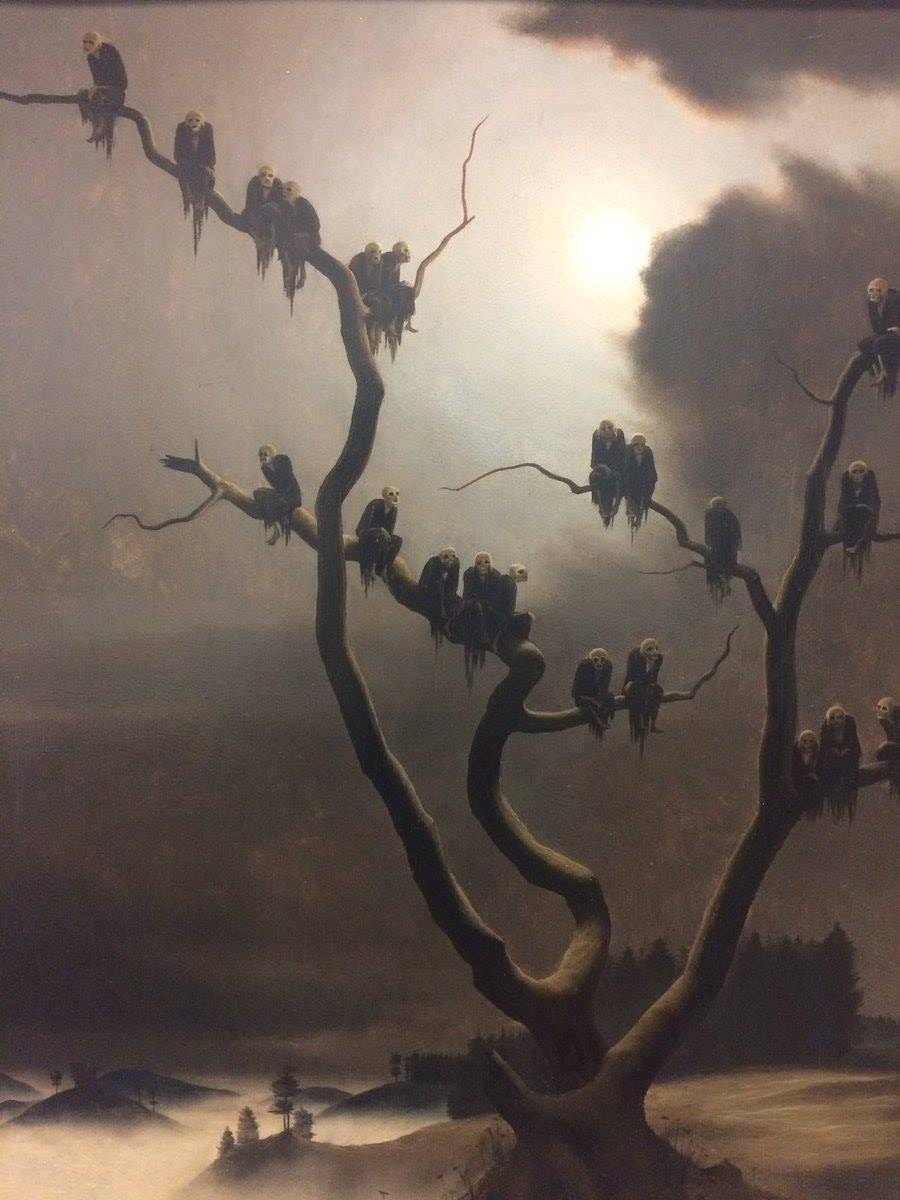
No image of the past is quite mislaid
By Nature; summer’s dog-days fade,
But back to earth at once will autumn fly;
The ghost of showers gathers in the sky.
—Autumn, Hölderlin
On Halloween day two years ago, Tucker Carlson confessed in a premiere for a Christian documentary to being molested by demons in the comfort of his own bed. The former Fox News host and current philosophe de comptoir was “left screaming”, covered in bloody sheets, his skin gored with the claw marks of an unseen force that neither he nor the four dogs in his bed could detect with the bodily senses. He described it as a very intense spiritual experience, which flung him into a sense of terror that could only be remedied through scriptural meditation. The world had drawn in to a single point, and was there immediately divided at the blade’s edge into the sides of good and evil. It required no reasoning, no explanation, no rape kit with sound chain-of-custody—Revelation, for Carlson, was at hand. In the end, he would remark back on the experience as a “beautiful” one. I am still unsure if this paragraph is about Carlson or a sorority girl in the Deep South.
Molested?

Of course, it is not exactly out-of-character for Carlson to make such claims. He believes UFOs are demonic, and even stopped researching them, as if he were in the chorus of Agamemnon, out of an inability to withstand its “darkness”. The atomic bomb was developed by demonic forces, too, and we should additionally throw in his assessment of Alex Jones’ prophecy of 9/11. It’s all rather neat and consistent, actually. Simple. When something lacks a direct, simple, and digestible material causation for events, he necessarily must make us open to the possibility of a non-material, non-causal explanation for the wondrous absurdities of life: in short, the supernatural. Where the former explanation fails, the latter rushes itself to the front ranks, proudly waving both shield and spear. The unseen triumphs over the visible, the simple over the complex, and the aloof over the immediate.
It isn’t necessarily just Tucker, either. An entire ecosystem of content is explained by this malaise, and unfortunately, it could even define large swathes of humanity.
The witty Drukpa Kunley (@kunley_drukpa) coined this inclination or state-of-mind as “djinnbrain”, which manifests in many forms, but is ultimately defined by him as “the tendency to believe that most events, especially bad ones, are the work of supernatural entities, like djinn, or some equivalent cultural stand-ins with motivated malevolent agency—particularly in lieu of more complex systems-orientated explanations.” This does not necessarily involve outright spiritual themes, one afflicted with djinnbrain may just as easily blame the sum of the world’s problems on “capitalism”, “neoliberalism”, “the Enlightenment”, and so on. In the most general terms, something is djinnbrained if the explanatory power of a statement can be replaced by “a djinn did it” without a loss in potency.
In America, we simply call these demons. The understanding and effect is essentially the same, still: any observance of inexplicable evil is owed to the acts and will of a demon. The more evil it is and more inexplicable or unreasonable it is, the more demonic it is, or rather, the stronger the demonic force attached to it. The demon, while still understood in its Biblical (really, Miltonian) lens, is less a force of nature than he is an agent of causation for things which occur in nature. It serves as an explanation, a theodicy, a demon of the gaps. Volcanic eruption? Demon. Coronavirus? Demon. Natural evil has always been explained this way. But what of the acts of mankind? You guessed it—demons. Every alteration in psychological states (lending to evil), every error in judgement, every temptation into misdeed, is caused by the act of a demon.
Any American who knew family from 3 or so generations gone-by know this sentiment with a fair degree of intimacy. I have stories in my own family of great-uncles being dragged to a ditch by a black demon, but I never got full clarification if the demon’s name was Jezebeth or Jamal. You must be careful of these things. Either way, even today it is a readily-found observance in American Christian culture that demons are everywhere and doing all sorts of things. Exorcism and household purifications remain among the most fascinating and intense spiritual experiences within American Christianity, doubly popularized by movies and ghost-hunter TV shows, which themselves were inspired by older real-life cases of demonic possession. It is also impossible to explain the moral panic over Jeffrey Epstein without first understanding its precursor in the “Satanic Panic” of the 80s & 90s which, so the motif goes, believed that Satanic cults were abusing and trafficking children in secret underground rituals.
Much of this, surely, is more alien to European Christians. Actually, I’m not so sure of that. Perhaps friends can enlighten me as to whether things such as the following case are widespread or local.
I like to tell the story of what I saw at a local church a few Halloweens ago. This is the sort of small-town church that claims no creed or denomination except for a love of Christ, hosts a Sunday school well-attended by children, feeds everyone after a service which is overwhelmingly hymns and worship songs led by drum-and-guitar—wonderful people, normal people. Which is why what I saw that night was completely bizarre, and to this day has perplexed me. As my family and I were going down a line of decorated carports in costumes badly assembled that afternoon, we could see through the subdivision’s neighboring tree line a large fire, which reflected a deep bronze glow off the church’s barndominium-style siding. There were people sort of milling, swirling, around this fire, singing a light hymn. What in the world are they doing?
We found out later, per their invitation posted on Facebook that evening, that this was in fact a ritual. Of course, they didn’t call it this, but the activities and rationale left little doubt. The community was asked to come out to the church this Halloween night to commune about a fire, into which they would cast household objects of evil and temptation. The list they provided was rather exhaustive: witchcraft items and books, tarot decks, horror movies, dreamcatchers, horoscopes, good luck charms, and mask souvenirs. Now why would any of that be necessary? The listing attached Acts 19:19, which describes Paul convincing the Jews of Ephesus to burn their scrolls relating to sorcery and demonic powers. Evidently, as it was for the Jews of Ephesus, the homely people around this Bonfire of Vanities had come to the conclusion that ordinary objects possessed extraordinary powers, and that the mere proximity to such objects incurred tangible spiritual results. Thus, a cathartic purge of the household was necessary. Into the fire went the costume mask, followed by a blu-ray of Supernatural (Season 2).

You will simply have to take my word in regards to the emotional intensity and spiritual urgency surrounding this event, these items were demonic. Out! I personally know people who were raised with incredibly strict bans on Harry Potter, and in one case Christmas itself, out of such fears and superstitions. Few people are not stunned, amazed, and eventually disgusted by such things. We could make this article into a long and predictable lecture about the life-denying and world-rejecting tendency in the most accelerated forms of Christianity, and it would not be wrong to do so. But I must admit that, on a sort of silly level, I can’t help but find myself charmed by the worldview of these people and of Tucker Carlson. It’s ridiculous, it’s harmful, it’s stifling… but it is religious. It is, in fact, incredibly pagan. Almost!
Yes, I am tormented yet fascinated, in a love-hate-relationship, with the so-called djinnbrained. On one hand, this psychology (if we may call it thus) is certainly intensified by the need to explain bad events and outcomes, thus, it is a firm continuation of that ancient world-rejecting tendency which seeks to explain the fact of evil with a finger pointed at the “demonic”. I would argue, too, that their rejection of the scientific dimension stems from their rejection of the world rather than their rejection of the intellect. To them, the intellect is God. Djinnbrain is curiously rationalistic, it stems substantially from a need for hyper-intellectualism, to fully and reasonably explain the world in concrete and causal terms. On the other hand, the recognition for a demonic presence in so many day-to-day things requires a religious frame of mind that is far more admirable than the agnostic status quo. Indeed, the repudiation of djinnbrain comes with an insinuated acceptance that all things could be explained by reason—by “more complex systems-oriented explanations”—and while clearly true in many instances, this is a blank check I am quite unwilling to write. I can only speak personally here (as my love for the natural sciences likely far exceeds that of the djinnbrained), but could it be that such explanations are limited in scope or otherwise tethered to more fundamental assumptions about life?
We do not have space here to initiate a comprehensive discussion between reason and irrationality, or science and art. We can only note for now that it has long been the project of both great artists and great scientists to unite the two under one activity. As for the common man, what is interesting about this angle, at least to me, is that this is far from a one-off bout of madness from a media celebrity who is well in over his talking head. This view of the world is older than man himself, and it remains everywhere still today; I would even journey to call it the default view. Those who would anticipate hardcore Evangelicals and similarly-minded people to completely reject the notion of “gods among us” have, surprisingly, been misinformed. We speak earnestly of a “Christian residue” in atheists, what if there was a residue of far more ancient beliefs within Christianity’s attempt of “fulfillment”?
Is Tucker Carlson, emblematic of a widespread belief… an animist gone awry?
Long before he had learned to separate his gods from the world, ancient man believed that every corner and crevice of the material world was possessed and filled with a divine nature—πάντα πλήρη θεῶν εἶναι, all things are full of gods (Thales). Before the god-of-rivers came there was simply the divine river, and prior to the thunder god was the experience and reverential awe of the holy bolt-and-crash. Every place, every region of being, belonged to and indeed once literally was the divine spirit itself. Every god was a “god of a place”, a genius loci: travelers journeying through distant and foreign forests made appropriate offerings to the unknown god of the forest, knowing that this place was intimately connected to the god. Bluntly, they were animists:
The whole of reality is both fully immanent and fully divine. Man himself is an aethereal ghost which can be, at the same time, sensed, touched, and indeed killed—as are the beasts, storms, deserts, clouds, stars, and forests around him. Crucially, this belief is not a mere catalogue of symbols with “deeper meanings”—man the animal knows nothing of the sort—nor are they poetic devices. When the African chieftain, as we are told in a contemporary anecdote by Klages, retires from the company of anthropologists because he has been overcome by a migraine induced by the angry spirit of his veneration-neglected ancestor, he is not engaging in literary wit: the tempestuous spirit of his deceased father has literally made an assault on his bodily senses, inflicting physical pain. Perhaps this is not too foreign to us today, as our ghosts come with the shadowy faces and bodies they once knew, wearing clothes, bearing weapons, emitting light, drawing in heat, and so forth. Even where the intellect fails and terror fills its void, the ability of bodily sense to comprehend prevails.

Here it is important to note two distinctions from djinnbrain. Firstly, it lacks the necessary components to seriously refer to the possibility of “evil spirits”. It is true that ancients understood relative positive and negative effects of divine forces, but they lacked a dualistic component understood them as malicious agents which always stood against goodness. That they could be prayed to or given offerings to appease their anger at all is enough evidence for this fact. “Harmful”, situationally and relationally, must be distinguished from flatly “evil”—beyond good and evil. Secondly, the gods and divine forces of animists were not explanations or causes for phenomena but the phenomena themselves. It would make little sense to blame a spirit for the volcano; the two were synonymous. Klages termed this fascination with an immanently-divine world with one that would surely horrify, yet accurately describe, individuals like Carlson: “polydaimonism”—a world of many demons!
The preliminary form and root of the knowledge of the reality of the images is polydaimonism. [...] The true daimon is the daimon of a place, of an area, of an element, changing with their appearances, accepting the sacrifices of its devotees, whose daily, monthly, or yearly rhythm is founded in the forms of its revelations, and is at work in those events or tasks which the spirit was driven to accept as powerfully effective by means of their pathically intuited images.
Elsewhere, he works with a more familiar understanding of daimons with “the atmosphere” of a particular place or setting. We understand this well. There is the atmosphere of the sea-cliff, of a church, an industrial park, a bad relationship on the brink. When Christians seek to “purify” a home by ridding it of the miasma of demonic artifacts (such as tarot cards, masks, and horror movies), they are engaging fully in this understanding. Here, again, we see the residue of far older attitudes.
In Klagesian terms, the difference between a demon and a daimon is that the former is an expression of spirit, and the latter of soul—the demon is a willing intellect, a person, who interacts with other egos (such as men) to achieve a desired outcome. But the daimon, conversely, is none of these things. It lacks personality, an ego, a willing intellect, a desired outcome. The daimon is rather the “aura” or essence of a thing, an expression of its character, that is, the revealing of its soul. Buildings have character (as a Christian offended by brutalism would argue); periods of history, distances, and many other abstract things, too. None of them are “persons”, but we are moved by them in similar fashion.
Daimon is thus the necessary complement to the Homeric view of the gods as individuals with personal characteristics; it covers that embarrassing remainder which eludes characterization and naming. —Burkert, Greek Religion, 3.5
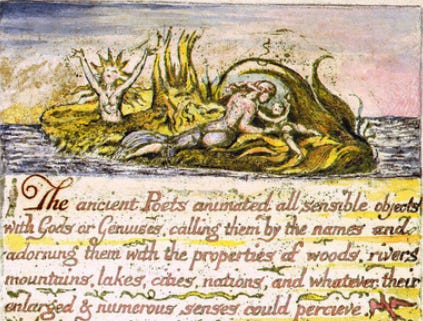
Despite the technical differences, it is worth reflecting that these people, most people, are not strict monotheists—nowhere close!—even if they declare themselves as such. The Christian system is such that it is God which saves his suppliant from these forces, if he so wills. Perhaps it can then be interpreted that, without the demonic, what use is salvation?
Indeed, for Carlson and all who share this worldview, the world truly is divine. All things are full of demons. If only they did not work so hard to kill them! The djinnbrained clearly and confidently wield this vision as yet another weapon in the arsenal of world-rejection, of which many blades and devices are levied to stage an assault. Every encounter of a magical and god-filled world for the djinnbrained is an encounter with evil; so strong is this sense that inexplicable evil and the demonic are synonymous categories. Consider the exhaustive list of demonic acts and entities provided by Carlson: thermonuclear bombs, warfare, genocide, anti-human AI, trannies, communism, The Elites™, and fentanyl addiction. Of course, no sane Christian would ever ascribe to the demonic anything good or valuable. But one must note here the longstanding conscription of “the demonic” as a sort of theodicy: evil could not come from God, and the inexplicable could not come from man. Therefore, all acts of inexplicable evil are outsourced to the Devil’s domain. I would argue that it is clearly the moral dimension, specifically a need to explain evil within Abrahamic metaphysics and culture, that drives the psychology of djinnbrain—not necessarily its want for the world to be explained in simple terms.
Conversely, the god-filled world that an animist speaks of is quite different. We too understand the world as god-filled: that every stream, forest, cliff, song, building, people, conversation, fate, birth, and moment of change is an expression of an underlying divine essence. However, we do not rely on this observation to make conclusions about the problem of evil, rather, we recognize divinity in every moment of awe, mystery, enthusiasm, and ecstasy. Unlike the djinnbrained, an animist sees the full range of emotions and effects which stems from a fully divine world, and has either not yet developed or simply rejected the notion that irrational, worldly forces must necessarily be evil. In a sense, they simply “are”.
I doubt Tucker Carlson would quite like reading this article if he was ever prompted to. Not many people would appreciate that their enlistment in a spiritual war against satano-paganism has its own roots in that old worldview; reports of its death, evidently, have been greatly exaggerated. Perhaps some would find us as endearing, so close yet so far, in the same way we view them. In either case, there is something about djinnbrain that I would quite like to preserve, to save it from a preference of “complex systems-oriented explanations”.
I require too much unavailable space to explain what I mean by this. A capacity for art and aesthetics, for now, can serve as an example. The Romantics, too, spoke rather freely about djinns, or “genius”, as they preferred—that is, again, the genius loci or “spirit of the place”. Genius also referred to ability, specifically poetic or artistic ability, but crucially it was not a rational or educated ability. Genius, being the inextricable essence of a thing or place, was synonymous with an inborn quality which remained inaccessible by mere intellect. This was the principal canvas in which the Romantic worked his brush in reply to the calculating cult of reason that had emerged in the Enlightenment: a belief in possessive, irrational forces for which mankind merely served as a vessel, along with every other form and fact of the sensible world. Goethe was more direct, and was certainly the target of much ire from the pulpit, when he referred to this force as not a comfortable and culturally-approved genius, but as the far more brazen daimonic: “that which does with the individual what he pleases”.
It was first the Romantics who rejected the false dichotomy between the Christian religion and its rebellious daughter named “Reason”. They too saw the world as god-filled, full of demons! But it did not lead them down a road of blind superstition, but in fact, the generation of new sciences: physics from Spinoza, evolution from Goethe, and psychology from Nietzsche. Nor did their artistic ability suffer; from them came some of our most precious works. All of it, they say, was guided by daimons.
Perhaps it is here that we can save the djinnbrained, reworking its diseased form back into its healthy and generative state. At this time of year, may we be all the more receptive to it.
“In poetry,” said Goethe, “there is definitely something demonic, and especially in the unconscious, where all understanding and all reason fall short, and which therefore also acts over all concepts.”
The same is true of music, to the highest degree, for it stands so high that no intellect can grasp it, and it exerts an effect that governs everything and of which no one is able to account. Religious worship, therefore, cannot do without it; it is one of the primary means of exerting a wondrous influence on people. […]
“The idea of the divine,” I said tentatively, “does not seem to incorporate the active force that we call the demonic.”
“Dear child,” said Goethe, “what do we really know about the idea of the divine, and what can our narrow concepts tell us about the highest being! If I were to name it a hundred times, like a Turk, I would still fall short and have said nothing in comparison to such boundless qualities.”
—Eckermann, Conversations with Goethe, Tuesday, March 8, 1831.

Absolute banger. Listened to it while delivering a dog up north to its new family.
It was just his dog that raped him in his sleep