


The following is part two of Istvaeonic’s guest series for Wandervogel.
Follow him here for more:
In our last entry, we discussed the origins of Germanic religion in man’s relation to nature. Here, we shall explore the place of the divine within the life of our ancestors through an examination of the Teutonic gods.
The natural origin of Germanic religion brings with it the connotations we discussed previously: the overflowing of vitality and the connection to the inborn. Applying these principles to the subject of Germanic religion, the Germanic man thrown into this world, these connotations apply to him through what is given to him—his body. Germanic man experiences that which is given to him from outside through his body, and this experience is what we call Germanic religion.
Walter Otto explores the full depth of the occidental European view of religion in his indispensable work The Homeric Gods. I will summarize some of his essential points in this article, and then I will apply them to Germanic religion specifically, since Otto focuses his analysis on Hellenic deities in Homer’s works. Of course, Germanic religion generally is far too large a topic, so to go into requisite depth I will apply Otto’s thesis to just one deity: Odin.
The European View of Religion
Otto focuses heavily on the Greek opposition to the miracle, which is the same basic thesis of this series of articles. The immediate reaction to this argument against miracles in religion is to discount that the resulting belief is a religion at all—to claim the gods are mere symbols our ignorant ancestors attached to their ignorant understanding of natural phenomena. The argument goes, e.g.: Germanic man chose to worship Thor (a word that literally just means “thunder”1) out of ignorance of the origin of thunder being the sound of electrostatic discharges, and now we in our enlightened scientific age only maintain Thor as a symbol for what we understand to be a perfectly rationally explainable scientific phenomenon. However, this argument is either dismissive of our European ancestors’ intelligence or their piety. If this argument were true, our ancestors, who built Greece and Rome, did not have the capacity to understand the causes of basic natural phenomena. This seems ridiculous, so many dismiss the piety of our ancestors as insincere symbolism. But, this contradicts the accounts of the very same people responsible for our ancestral achievements as their accounts show they were deadly serious about their religion. Therefore, it is not that our ancestors’ religion was false, but instead that the view that religion is necessarily miraculous is false.
Otto wrote that the authentic European view, personified by the Greeks, is the gods are nature:
The Greek deity does not operate from the beyond upon the inwardness of man, upon his soul, which is connected with it in some mysterious way. The deity is one with the world and approaches man out of the things of the world if he is upon the way and participates in the world’s manifold life. It is not through turning inward that man experiences deity but by proceeding outward, seizing, acting. To the man who is active and enterprising the deity presents itself with immediacy, whether it facilitates or hinders, enlightens or confuses.2
In the fullness of life as man experiences it through his body, the divine is within everything. Man’s activities are subject to the same wonder that objects or phenomena in nature are, and thus are effused with the divine in the same way per Collin Cleary’s thesis.3 We may still use the term “miracle” when discussing European religion to refer to the presence of a god, but we do not do so in the commonly accepted sense that requires the contravening of nature. Otto goes on to say, “the miraculous is no alien impingement upon nature but a momentary emergence from its background which may suddenly shock the soul of the elect and arouse in it a premonition, in some cases even a clear recognition, of the divine.”4 A European religious miracle thus is the intuition of the divine within a human activity. Think Tyr steadying the hand of a warrior as he plunges his spear into an enemy’s throat. European man sees divinity in all his actions and affords this divinity its due respect. A man who participates in a certain activity (i.e. if he is upon the way) partakes of the god of that activity. This is why Tyr is a god of war, justice, and law – for man recognizes Tyr’s work when pursuing activities in these fields.
The urge to recognize the divine in everything demonstrates the wonderous thinking of our ancestors expounded upon by Collin Cleary. Otto entertains a counterfactual in reference to Homeric myth to demonstrate this point:
But if we expect that here the miracle will be contrasted with natural ways we are greatly mistaken. Here too the miraculous grows out of the natural situation and shows the man experiencing it—who remains the sole witness—its eternal and divine visage. The introduction of a deity is never required to make an event intelligible in our sense. The stories could all be told without the slightest reference to deity, and they would undergo no substantial change. But the spirit of the Homeric world makes these references necessary, for it must link every decisive factor to the divine, however intelligible it may be to us on natural grounds.5
That the Iliad could be told secularly is a perfect demonstration of European religion’s antithesis to supernaturalism. I highly recommend Michael Michailidis from Ancient Greece Revisited’s video on the topic exploring a take on such a telling:
Nevertheless, such a telling would impoverish the story by excluding the real and important divine aspects our ancestors included in the Iliad. This impoverishment would be my only real argument against something like atheism (of which I still have a much better view than any superstitious religion). In sum of the foregoing on the European view of religion, I quote a relevant passage of Otto’s in full:
It is in the most astonishing images of divine manifestations, then, that we can most plainly see how alien to the spirit of true Greek piety is miracle in the commonly accepted sense, which other religions seek out and sanctify. That piety is the more significant in that the same spirit accomplishes all things, from the greatest to the least, through the gods, indeed conceives of them as being accomplished by the gods themselves; and it is so completely alive to this relationship that it never forgets to emphasize the role of the divine even when the prowess of the most admired heroes is to be celebrated. The deity that is here the object of faith is not an absolute master over nature who exhibits his sovereignty at its loftiest when he compels nature to act contrary to itself. It is the sanctity of the natural itself and one with its sway, present with its spirit in all that can be experienced and received with reverence by the pious soul. It is demonstrated as well in what is very simple and perfectly regular as in astonishing and awesome experiences of which only a great heart is capable. In the epic, to be sure, where mighty men do and suffer, it is the extraordinary that is repeatedly brought before our eyes. But everywhere it presents itself in the same sense: not as the miracle of a god triumphing over nature, but rather as the experience of a great heart to whom—and to whom alone—at the height of his being and doing the deity presented itself out of the ordinary lines of nature.6
Odin
Now we can look to how our Germanic ancestors experienced Odin in their lives and how this experience even survived Christianization itself. The impression given of Odin through a survey of the many myths of his exploits gives a consistent picture of qualities one might not expect to be present in the chief deity of a pantheon: craftiness, resourcefulness, ingenuity, and deception. Of course, these too connect to another of Odin’s characteristics, which serves doubly as one of his main pursuits: magic.
In Vafþrúðnismál Odin travels to the hall of the jotun Vafthruthnir for the sole purpose of testing his wisdom against that of the wisest of jötnar in a game where the two test each other’s arcane wisdom, with the penalty for failing to answer a question correctly being death. Odin conceals his identity to Vafthruthnir by introducing himself as Gagnrath (“one who advises against,” or “antagonist in argument”).7 His lie about his identity is revealed when he asks Vafthruthnir, “What spake Odin himself in the ears of his son, ere in the bale-fire he burned?”8 Vafthruthnir quickly realizes that the only person who would know what Odin spoke to Balder at his cremation would be Odin himself, recognizing Gagnrath to be Odin and conceding both defeat and his life to Odin in the game.
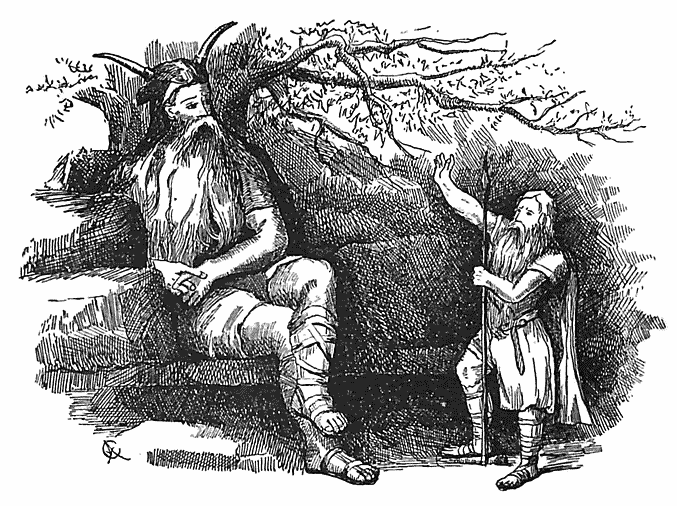
The Gesta Danorum recounts a tale whereby Odin, wishing to find a way to avenge the death of his son Balder at the hands of his other son Hodur without killing him himself, consults oracles on how to do so. They tell him that he must have another son, Váli, who will kill Hodur and imprison Loki for Loki’s orchestration of Balder’s death. To beget Váli, Odin must impregnate a Slavic princess named Rindr. Odin disguises himself using Seiðr and attempts to win her over by winning multiple military victories for her father and smithing ornate jewelry for her, but he is rebuked each time. Instead, he presses runic staves into her flesh that cause her to fall ill and again disguises himself, this time as a female healer, and tells her father that he must administer a cure to her disease that would cause her to violently vomit. The only way to help her keep the medicine down would be to tie her to her bed. Her father allows this, but instead of administering medicine, Odin rapes and impregnates Rindr.9 Rindr gives birth to Váli, who kills Hodur and then ties Loki to a rock with the entrails of Loki’s own son—both tasks necessary to defend the cosmic order in the forthcoming Ragnarok.
These accounts not only show Odin’s methods, but also his goals. In both Odin attempts to get the most favorable outcome, to win, by any means necessary. He lies, cheats, kills, rapes, and even disguises himself as a woman and uses feminine Seiðr magic when appropriate to achieve his goals. The goals for which he makes these sacrifices also demonstrate his character: the pursuit of wisdom and the maintenance of the cosmic order. Odin risks his life in a game with Vafthruthnir so he can both test himself but also get the opportunity to ask the wisest of the jötnar about the secrets of nature. Odin performs dishonorable actions like disguising himself as a woman in order to set in motion the fated events of Ragnarok. I am sure readers are also familiar with the oft-repeated tales of Odin shapeshifting to steal the mead of poetry, sacrificing himself to himself hanging from a tree for nine days and nights to acquire the runes, and sacrificing his eye to sip from the wisdom of Mímir’s well.
Odin’s methods and ends demonstrate his divine sphere of operation; as Otto says of Hermes, “This signifies a huge expansion of the divine sphere of operation. Its compass is no longer delimited by human wishes but rather by the totality of existence. Hence it comes about that this compass contains good and evil, the desirable and the disappointing, the lofty and the base.”10 Odin’s methods are effective and divorced from morality, implicating and attaching a plethora of positive and negative aspects of the human experience. Otto’s further comments on Hermes are also appropriate: “Though much of this must seem questionable from a moral point of view, nevertheless it is a configuration which belongs to the fundamental aspects of living reality, and hence, according to Greek feeling, demands reverence, if not for all its individual expressions, at least for the totality of its meaning and being.”11
Man, and I mean this in a gender-specific way, intuits Odin in his noblest aims (specifically noble, nothing to do with morality). It is no coincidence that Odin is the god of the nobility. The pursuit of knowledge of all things, of victory and martial skill, and an obsession with one’s fate are all well-known characteristics of the higher type of man in European civilization. Of course, it is not only important what man does to experience Odin but also how man experiences Odin.
His name gives us a hint, for Odin derives from a Proto-Germanic word, *wōdaz (ᚹᛟᛞᚨᛉ), meaning rage, manic inspiration, furor poeticus.12 As Adam of Bremen wrote, “Wodan id est furor.” Odin is the frenzical inspiration that drives the higher man towards his pursuits, the pursuits that separate the rare man from mere life. The myths clearly show the Odinic pursuits to be connected with frenzy, most famous being Odin’s sacrifice of himself to himself in the Hávamál: “I took up the runes, shrieking I took them, and forthwith back I fell.”13 However, instead of again quoting from numerous millennia-old myths to demonstrate human experience, I will show some more recent examples of the experience of Odin in Germanic man to demonstrate the frenzy of the High One persists to this day. If you can forgive a long passage, a story from Carl Jung is quite illustrative here:
On [a] still night when I was alone in Bollingen … I awoke to the sound of soft footsteps going around the Tower. Distant music sounded, coming closer and closer, and then I heard voices laughing and talking. I thought, “Who can be prowling around? What is this all about? There is only the little footpath along the lake, and scarcely anybody ever walks on it!” While I was thinking these things I became wide awake, and went to the window. I opened the shutters—all was still. There was no one in sight, nothing to be heard—no wind—nothing—nothing at all.
"This is really strange,” I thought. I was certain that the footsteps, the laughter and talk, had been real. But apparently I had only been dreaming. I returned to bed and mulled over the way we can deceive ourselves after all, and what might have been the cause of such a strange dream. In the midst of this, I fell asleep again—and at once the same dream began: once more I heard footsteps, talk, laughter, music. At the same time I had a visual image of several hundred dark-clad figures, possibly peasant boys in their Sunday clothes, who had come down from the mountains and were pouring in around the Tower, on both sides, with a great deal of loud trampling, laughing, singing, and playing of accordions. Irritably, I thought, "This is really the limit! I thought it was a dream and now it turns out to be reality!" At this point, I woke up. Once again I jumped up, opened the window and shutters, and found everything just the same as before: a deathly still moonlit night.
…
It was only much later that I found an explanation. This was when I came across the seventeenth-century Lucerne chronicle by Rennward Cysat. He tells the following story: On a high pasture of Mount Pilatus, which is particularly notorious for spooks—it is said that Wotan to this day practices his magic arts there—Cysat, while climbing the mountain, was disturbed one night by a procession of men who poured past his hut on both sides, playing music and singing—precisely what I had experienced at the Tower. The next morning Cysat asked the herdsman with whom he had spent that night what could have been the meaning of it. The man had a ready explanation: those must be the departed folk—sälig Lüt, in Swiss dialect; the phrase also means blessed folk—namely, Wotan's army of departed souls.14
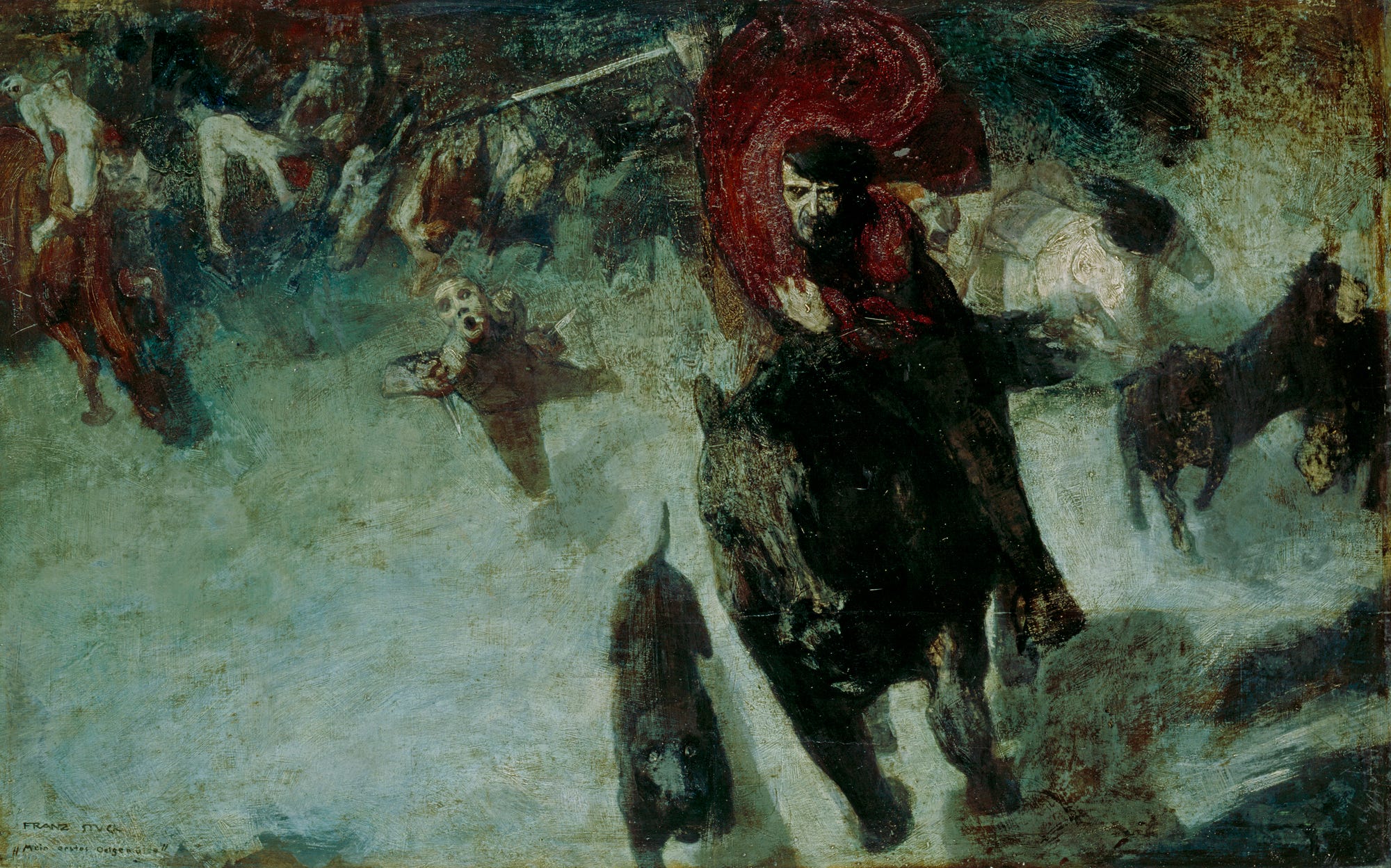
As Christianity stripped away the mythic and outward facing aspects of Odin in popular culture, he survived more and more through people’s direct experience with his character in a state of frenzy. Tales like this from Jung survive all over the Germanic world, with similar occurrences reported in England, Scandinavia, and Germany. To me, the most profound modern recounting of the Odinic frenzy possessing one in their realization of their Odinic path is the teenage enlightenment of Adolf Hitler towards his political goals as given by his childhood friend, August Kubizek. In a chapter I highly recommend reading in full, Kubizek recounts how, after seeing a musical performance of Wagner’s Rienzi, Hitler silently led the two of them up the peak of the Frienberg in the middle of the night. Once there, under the stars and feverish with excitement, Hitler erupted, hoarsely and raucously, how he was destined to lead the German people to the heights of freedom.15 Kubizek noted of Hitler,
I was struck by something strange, which I had never noticed before, even when he had talked to me in moments of the greatest excitement. It was as if a second ego spoke from within him, and moved him as much as it did me. It was not at all a case of a speaker being carried away by his own words. On the contrary, I rather felt as though he himself listened with astonishment and emotion to what burst forth from him with elementary force. I will not attempt to interpret this phenomenon, but it was a state of complete ecstasy and rapture, in which he transferred the character of Rienzi, without even mentioning him as a model or example with visionary power, to the plane of his own ambitions. But it was more than a cheap adaptation, the impact of the opera was rather a sheer external impulse which compelled him to speak. Like flood waters breaking their dykes, his words burst forth from him. He conjured up in grandiose, inspiring pictures his own future and that of his people.16
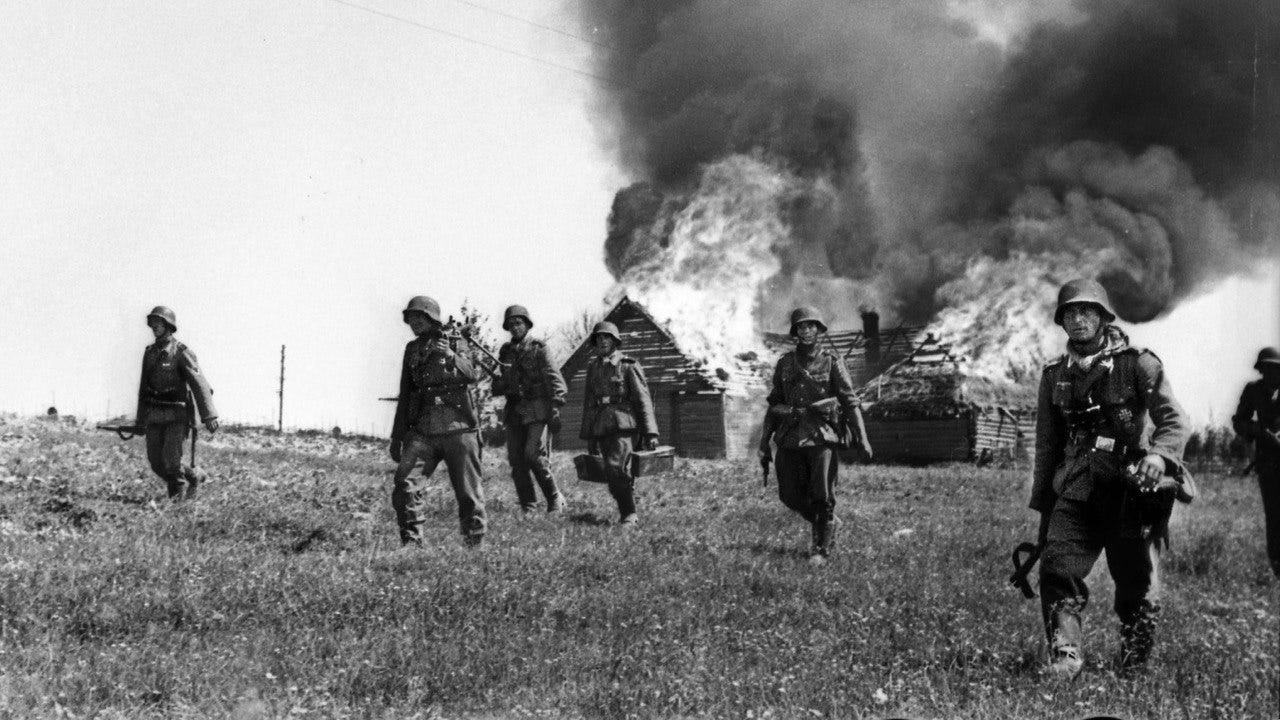
Hitler’s actions in life were downstream from a moment of total and complete frenzy where he was gifted the foresight of his destiny, and this frenzy spread through him, its conduit, to the rest of the German people and ended up bringing about the largest war in human history as four million men invaded the East across a two thousand mile front in a racial struggle for the expansion of the German race: Operation Barbarossa. This proves a parallel to Odin’s rape of Rindr to prepare for the ultimate war with the jötnar at Ragnarok.
Another aspect latent in the Christianization of the Germanic people was the tendency to equate Odin with Satan, and many of the popular aspects of Satan have their origin in Odin. This can give us another lens to understand the place of Odin in nature, for we can use the vessel of Satan to understand the continued development of Odin in a post-Christianization age. Furthermore, an oft-repeated aspect of Satan is his “temptation” of man, like the image of the serpent whispering to Adam and Eve to partake of the fruit of knowledge. This whispering is the very same Odinic frenzy experienced by our Germanic ancestors. Jung again speaks of an example of such an equivocation when discussing a popular German folk-tale:
From a psychological point of view the motif of the rats, which seems to have been added afterwards, is an indication of Wotan’s connection with the daemonic and chthonic realm, and with evil. Wotan was banished by Christianity to the realm of the devil, or identified with him, and the devil is the Lord of rats and flies. The story of the Pied Piper, as well as the medieval movements mentioned by H. Scholz and Dr. Schmitz-Cliever, are symptoms of a pagan spirit working in the unconscious and not yet domesticated by Christianity.17
Christians even went as far as directly equivocating sites where Odin was historically worshipped with Satan. One such is the “Wotanstein” in Hesse, Germany where a historic site of Wotanic worship for the Chatti tribe gave rise to a local legend that the neolithic menhir that formed the center of the site was a stone thrown by Satan in an attempt to destroy a local church.18 From this we can glean other general characteristics of Wotan as taken in the consciousness of Germanic peoples long into the era of Christianization—Milton’s depiction of Satan in Paradise Lost as well as the later character it inspired, Cormac McCarthy’s Judge Holden, come to mind. Nietzsche’s “will to power” also captures a surviving aspect of the Odinic spirit:
Even a body within which … particular individuals treat each other as equal (which happens in every healthy aristocracy): if this body is living and not dying, it will have to treat other bodies in just those ways that the individuals it contains refrain from treating each other. It will have to be the embodiment of will to power, it will want to grow, spread, grab, win dominance, – not out of any morality or immorality, but because it is alive, and because life is precisely will to power.19
The animating frenzy that drives man’s striving towards war, expansion, knowledge of the world, knowledge of one’s own future—the thunderbolt that animates a select few—this is Odin. That an irreligious man like Nietzsche could intuit and give voice to Odin through his lived intuition demonstrates Odin’s perfect position among nature and opposition to the supernatural. Odin is a fundamental aspect of reality that our Germanic ancestors revered, and many still do unconsciously. Odin’s magical tales of shapeshifting illuminate a key aspect of Germanic man’s being in the world. Much more could be written on the topic of Odin, as I have merely scratched the surface here, but this concise picture demonstrates how similar the Olympic qualities ascribed by Otto to the Greek gods are to the Germanic god Odin. Odin’s clear position within nature may lead to a convalescence of pagan thought on the god in the modern world. What still remains from the threads of thought started by this entry and the prior in this series is weaving together the original naturalist understanding of Germanic religion with an understanding of how this applies to divinity through analysis of a myth from a natural perspective. This will be the next entry in this series.

Thanks for reading!
Wiktionary, s.v. “Þunraz,” accessed May 31, 2026, https://en.wiktionary.org/wiki/Reconstruction:Proto-Germanic/%C3%9Eunraz.
Walter F. Otto, The Homeric Gods, trans. Moses Hadas (Thames and Hudson, 1954), 174. Italics in original.
Otto, The Homeric Gods, 210.
Otto, The Homeric Gods, 213.
Otto, The Homeric Gods, 226–7.
Rudolf Simek, Dictionary of Northern Mythology, trans. Angela Hill (D. S. Brewer, 1993), 97.
“Vafthruthnismol” in Poetic Edda, trans. Henry Adams Bellows (Imperium Press, 2022), 111.
Saxo Grammaticus, “Book III” in The Nine Books of the Danish History of Saxo Grammaticus, vol. 1, trans. Oliver Elton (Norroena Society, 1095), 191–6.
Otto, The Homeric Gods, 121.
Otto, The Homeric Gods, 122.
Wiktionary, s.v. “Odin,” accessed May 31, 2026, https://en.wiktionary.org/wiki/Odin.
“Hovamol” in Poetic Edda, trans. Henry Adams Bellows (Imperium Press, 2022), 77.
Carl Gustav Jung, “The Tower” in Memories, Dreams, Reflections, ed. Aniela Jaffé, trans. Richard Winston and Sarah Winston (Vintage Books, 1965), 229–31. Italics in original.
August Kubizek, “‘In That Hour It Began…’,” in The Young Hitler I Knew, trans. Geoffrey Brooks (Greenhill Books, 2006), 117–8.
Ibid.
Carl G. Jung to Melvin J. Lasky, September 1956, Letters of C. G. Jung: Volume 2, 1951-1961, 330–2.
Thomas Witzke, “Menhir "Wotanstein", Maden, Gudensberg bei Kassel,” Strahlen.org, last modified February 2008, https://tw.strahlen.org/praehistorie/hessen/madenwotanstein.html.
Friedrich Nietzsche, Beyond Good and Evil, trans. Judith Norman (Cambridge, 2019), 153. Italics in original.
Excellent article.
To me, the word ‘supernatural’ never meant it’s literal meaning regarding something from above or beyond nature, rather is was a word to describe the blending of layers of natural activity. When the mundane gives way to the sacred.
I might then propose the word ‘intranatural’ as a replacement.