


Jung on the contrary lacks the impressive vividness of Klages, and his work has nothing like the same weight. He is the deft master of all the means of interpretation, but the inspiration is missing. Klages has inspiration, in as much as he is the true successor of Bachofen, whose work he rediscovered.
—Karl Jaspers, General Psychopathology, p. 334. (as cited by Paul Bishop)
Despite being thinker of monumental historical importance, the Swiss scholar and anthropologist J.J. BACHOFEN died in 1887 with little to be said of his works in regards to the hopes of a lasting influence. For a generation, his theories of the religious grave-symbols of ancients in Versuch über die Gräbersymbolik der Alten (1859) and the origin of matriarchies in Das Mutterrecht (1861) went on with little public or academic attention. In this moment, it had seemed that the mere “poetic reconstructions” that Bachofen’s contemporaries had so effortlessly brushed to the side were bound to be relegated to the dark and dusty corners of libraries.
The assumption revealed itself to be both right and wrong. To the neglected corners of bookshelves did Bachofen’s works did they indeed go, but it was precisely in this condition that they were rediscovered around the year 1900 by a group of mystic poets and philosophers in Munich known as the Kosmikerkreis—an offshoot from Stefan George’s literary circle—which included Alfred Schuler, Karl Wolfskehl, and Ludwig Klages. While touring the extensive private library of his father’s estate, Wolfskehl happened upon an 1861 copy of Bachofen’s Das Mutterrecht, and soon brought it to the attention of Klages.1 He was immediately enraptured by the text, and what followed was a 30-year effort of enthusiastic service by Klages to revive the works and ancient symbolism of Bachofen—though, with his own interpretation of him at the forefront.
Bachofen possessed remarkable insight in all of his endeavors, but perhaps his most prescient decision was to marry the 19-year-old Louise Burckhardt at the age of 50. Her relative youth and noble upbringing gave her the knowledge and circumstance to carefully nurture the scattered works and notes of her deceased husband for decades, until Klages—not from any academic position (which he never acquired), but out of his own personal initiative—began correspondence with her in the summer of 1919, seeking to bring his theories back into the public. The cooperation between the two was fruitful beyond all measure. With the help of Carl Bernoulli, another admirer of Bachofen, a number of forgotten and newly-published works were gradually available for readership in Germany. These included Das Mutterrecht (as Rudolf Marx’s Mutterrecht und Urreligion, 1927), Versuch über die Gräbersymbolik der Alten (1925), Bernoulli’s Johann Jacob Bachofen und das Natursymbol (1924), and Klages’ Vom Kosmogonischen Eros (1922). The timing was almost providential—Louise would pass away just months later in February of 1920.
Suddenly, Bachofen was everywhere: Klages had succeeded in instigating a veritable “Bachofenian Renaissance” in Weimar Germany. The old jurist was, evidently, far more influential than Klages had anticipated, as not everyone had the same mythopoetic vision for his works that he had in mind. Thus, he soon found himself embroiled in bitter conflict with multiple other factions over whose interpretation of Bachofen would rule the narrative of his legacy. Through Alfred Baeumler, the (anti)historical and ideological narrative was developed in service to a “myth of the blood”, which went on to directly influence Alfred Rosenberg’s Myth of the 20th Century, and the whole of National Socialist views of antiquity with it. Meanwhile, the Marxist interpretation of an ideal primordial communalism and material analysis of gender relations first set out by Engels and Peter Kropotkin was furthered by the left in Weimar, an approach championed by Walter Benjamin. Feminism and suffrage movements too were dominating the air of Berlin at this time, and they made quick use of Bachofen’s theory of primordial matriarchy and support for the role of women in law and culture. Helene Stöcker, for example, promoted the sexual autonomy of women in early attempts to legalize eugenics and abortion upon the notion that women held the sole legal right to the fate of their offspring—a conception pulled directly from the pages of Mutterrecht. Spengler, too, made extensive use of Bachofen’s language of symbols in his then-controversial Decline of the West, and even participated in public debates on Bachofen in 1925.2
It was in this lively context that the 1925 edition of Gräbersymbolik der Alten was published. Accompanied with a foreword by Bernoulli and a tribute (Würdigung) by Klages, it was in one sense an effort to provide the “final say” on this intense public debate over the legacy and meaning of Bachofen. Clearly, Klages was incensed by the public debate and the many frustrations produced by it—even going as far to indicate that Bachofen’s newfound popularity was worse for his legacy than his previous neglect. For while others saw in Bachofen a material analysis of gender, an evolutionary account of human society, or of the mythic basis of civilization, Klages saw in Bachofen the very essence of myth and life itself: Bild—the symbol, or image. Bachofen, despite errors in interpretation and a Christian bias, “succeeded in liberating the image [das Bild] of the primordial soul from millennia of whitewash, permitting us to but only glimpse at its ineffable beauty.” Bachofen intended his work to show the fruits of human progress away from “swamp-like” Hetaerism and Demetrian mother-right towards the patriarchal “celestial order” exemplified by Roman imperial law, but Klages credits him for too perfectly illustrating, through ancient symbols, the symbol-rich inner life expressed by man in his original state—unmolested by the follies of egocentric willing, reason, and progress. What Klages was pulling from Bachofen may be readily compared to what Jung was pulling from Jacob Burckhardt in “primordial archetypes”, likewise in the early decades of the 20th Century. Remarkably, there is little evidence of any correspondence between Klages and Jung, though, the connection may be a consequence of the fact that Bachofen and Burckhardt themselves were well-acquainted colleagues.
In Gräbersymbolik, Bachofen offers what may be considered as the field sketches of what would be refined in Mutterrecht two years later. This work was nothing short of a grand interpretive study of the myths and symbolism of antiquity, acquired through a contemplative reflection of the grave artifacts and tombs of the most distant periods known at the time. This effort went beyond the desk-study of sketches and lithographs; Bachofen found great meaning in his personal tours of Etruscan tombs and archaeological sites. What the Etruscans provided to Bachofen was the unavoidable sense that, to primordial man, matters of death and rebirth offered the most vibrant, gripping, and sincere expressions of religious symbolism above any other area of human life. These symbols provided, in part, the now-familiar image: the terrifying completeness of certain annihilation, inseparably paired with the ceaseless generation of new life. But for Bachofen, greater significance of these symbols was found in that they necessarily preceded law, morality, or any such custom of higher civilization. Thus, they not only reflect the inner life of primordial man, but the evolution of symbols over time reflects the evolution of societies and human consciousness itself. Klages frequently praises Bachofen for providing these additional scholarly insights, even if they sometimes create confusion. One would expect confusion in a completely novel investigation which takes upon itself such a wide area of study and interpretation, and it is precisely on these terms that Klages offers his “appreciation”.
The following is a full English translation of Klages’ tribute to Bachofen for the 1925 publication of Gräbersymbolik der Alten. Much of it has not been translated before, though, it includes an extensive passage from the final pages of the concluding “Literature” section of On Cosmogonic Eros that has already been translated before. I have included this section with my own translation for consistency of prose, yet, I am of course indebted to the existing English translations for assistance, as well as the many compiled works on Klages, particularly Paul Bishop’s Vitalist Toolkit. However, accessible translations of this section are evidently lacking, therefore, I intend the following translation of this section to provide a more clear and communicable image of the text. Indeed, Klages is notoriously difficult to translate, therefore I have made an extensive effort to retain the “character” of his prose and style with a number of different tools, sources, and models. Nevertheless, errors are certain, and I welcome future revisions as those efforts are embarked upon by others.
On Bachofen
Even if we were not lacking in time for a worthy appreciation of Gräbersymbolik, we could hardly better fulfill the publisher’s request to accompany this monumental work with an explanatory introduction than by reproducing those sentences of our book On Cosmogonic Eros from which, three years ago, came the decisive impetus in the awakening of an interest that quickly spread throughout the widest circles in the personality of Bachofen, and his hitherto never fully appreciated significance in the study of religion. The passage in question forms the second and concluding part of a retrospective study which seeks to outline the main threads of the preceding century’s research into myths and mystery cults, and the enduring contributions of the era of post-Romantic thinkers, particularly of men such as Laistner, Mannhardt, Pfannenschmid, and Rohde:3
However highly one may appraise the pioneering value of some of the above works, none of them have brought about a fundamental change in our understanding of the primitive state of consciousness. It would be going too far to claim that he had already become associated with the two figures we are about to discuss; but we may at least say that he is beginning to be associated with one of them, and we further maintain that he is destined to find the fullest realization in the second. Nietzsche’s The Birth of Tragedy signifies the beginning of a new interpretation of the psychological [seelischen]4 foundations of antiquity, thus all of prehistory in general, and henceforth it must be known and critically integrated by anyone who wishes to venture into the study of symbolic thought and mythic dreaming. The minor shortcomings of this immensely significant work are to be seen in light of its adoption of Schopenhauerian terminology, and in its inclusion of problems of music—especially of those connected to the Wagner cult. One essential defect, however, lies in that rather vague and limited conception of the Apollonian, which prevented its discoverer from recognizing its essential equivalence with the “Socratism” he knew so well! But even before Nietzsche revealed through his great renewal of our understanding of the metaphysics of the Dionysian the opposition of the primordial state of the soul with the daylight world of the Olympians, the thought of another scholar had already accomplished what the study of folk mythology—and with it the philosophical yearning of the whole of the Romantic movement—had long sought in vain: namely, the insight that, certainly among the Mediterranean peoples, but likely throughout humanity as a whole, the Chthonic principle of nocturnal consciousness preceded the Uranian principle of waking consciousness, which everywhere yielded to it only after a long, difficult, and at times bloody struggle.
It was J.J. Bachofen (1815-1887) who undertook with his two major works Mother Right and Grave Symbolism of the Ancients the effort to interpret the entire prehistory of the Occident from the standpoint of a conflict between “matriarchy” and “patriarchy”, and with prophetic certainty uncovered in myths and symbols the underlying substratum of their most ancient formative impulses, and with unparalleled scholarship succeeded in supporting the thesis that there once existed a primordial religion which was indifferent to the barriers of time and nations, whose characteristic forms of social customs, legal concepts, and representations of gods stand in the starkest possible contradiction with every last conviction and commandment of the rational bearer of world-history! The matter did not go unnoticed—the ethnologists were the first take it up and, ‘lo and behold, researchers such as Morgan, Kovalevsky, Lubbock, and others5 were able to document among many so-called “primitive” peoples the continued existence of precisely those customs and institutions that Bachofen had merely inferred from the cultic ideas of antiquity! Both ethnology and legal scholarship have by now incorporated Bachofen’s concept of mother-right. Proponents of communism, such as the highly-learned Kropotkin6, sought to use it to forge weapons from mankind’s natural history against the capitalist dogma of private property. Passionate debates erupted about the nature, age, and origin of the family, and in retrospect have significantly contributed to the deepening of our knowledge of humanity’s earliest tribal formations. But who today has even the faintest idea that Bachofen should be recognized as the greatest revealer of that primordial state of consciousness in relation to those mythical and cultic outpours [Niederschlagen] which in comparison make, without exception, every religious doctrine of historical humanity appear as but a dilution or decomposition of the original source!
The author of these lines freely confesses that his first encounter with Bachofen’s major works around the turn of the century was his greatest literary experience, and it decisively shaped the course of his life. Some of these inspirations he passed on, at that time, to a small circle of Munich scholars and writers have continued to exert an influence—more or less anonymously. But on the whole, the philosophy of religion and study of myth has still not arrived to where Bachofen had already stood in the sixties of the previous century. For works such as Albrecht Dietrich’s Mutter Erde (1905), which admittedly at first glance appear to follow similar lines of inquiry (without, by the way, ever mentioning Bachofen, as far as we can see!), nevertheless fall immeasurably short of the pioneer’s works in both profundity and depth of vision—Bachofen demonstrated proof of the Romantic principle of polarity’s origin in the primordial consciousness of mankind, by means of a body of evidence that has still not even remotely been exhausted. Earth and heaven, night and day, moon and sun, water and fire, left and right, and so forth, belong together as inseparable pairs like body and soul [Leib und Seele] do; and they are conceived through that same interrelation as perpetually renewing the world, just as do the feminine-receptive and masculine-procreative principles. This union of opposing symbols is embodied by those of both the mother and the child, whose own polar interconnectedness carries the mystery religion of the eternal cycle. The whole process of the cosmos itself is thereby conceived under the image of a motherhood which continuously renews its own youth through the ceaseless birth of the child. Accordingly, every individual living being enters into a binding relation of dependence with not to woman, as Bachofen believed, but to the one universal Mother—or more precisely, the egg, the life-cell. His misidentification results in an overvaluation of receptiveness [of soul] and pregnancy over the generative principle itself, which is regarded, so to speak, as performing merely an auxiliary function; the consequences of this for the shaping of ethics are incalculable.7
Bachofen proved in meticulous detail that there was indeed, beyond good and evil, a “natural law” which was disturbed by no legislative arbitrariness, and preserved the most intimate connection both between mankind and the world and among human beings themselves. While he, through the thoughts of his heart, in countless interpretations of symbols unwaveringly pursues the effort we just mentioned—we need only to recall his uncovering of the original meaning and customs of the Greek Agon, a clairvoyant insight which remains unparalleled in the whole of mythological studies—the thoughts of his head were under the influence of the Christian religion of the Will, and led him to regard the process (partly attested by prehistory and partly by history) whereby Geist, inherently alien to the images, slowly takes possession of the day-side of Life, as a self-overcoming and higher development of the primordial state. The very same scholar who, on one hand, praises the self-contained perfection of maternally-embracing Chthonism with words that murmur [rauschen] like subterranean springs, and by comparing it to everything that came later as peaceless unrest, actually manages to, on the other hand, misunderstand that intrusion of a peace-disrupting adversary as a progression to a “higher stage” of civilized order! This bewildering oscillation between heart and head, of which its bearer himself was wholly unconscious, was certainly one of the chief obstacles to our understanding of the great discoverer and the recognition of the significance of his achievement.
Nevertheless, Bachofen succeeded in liberating the image of the primordial soul from millennia of whitewash8, permitting us to but only glimpse at its ineffable beauty. To provide the epistemological key to the profundity and truth of this image, is one of the central tasks of our lives.
This is not the place to illustrate the points of connection between our own findings and those of Bachofen, nor to speak of our companion Alfred Schuler, who has unfortunately departed far too soon—his distinctive development of the fundamental ideas of Bachofen will be revealed only through his literary estate [Nachlaß].9 As already mentioned, we must refrain from discussing Gräbersymbolik in greater detail, and wish only to note here that it offers the deepest and most comprehensive interpretation of the agonal circus games. Instead, let us have a word about Bachofen’s belatedly emerging fame.
If Plato’s wise saying “Many are the thyrsus-bearers, but few are the initiates”10 was ever true, then it certainly is so today. Scarcely has a thought of profound sense been voiced before crowds of the uncalled press forward to shout it aloud, as though it were their own property. One acts out a performance as if he has long known what he has only just heard, and outdoes himself in exaggeration of its import. Men of letters fabricate novellas and dramas out of it; adventurers falsify without hesitation their accounts of regions still somewhat inconvenient to travel through, and nine-times-wise11 pseudo-historians find themselves in the enviable position of being permitted to henceforth rid themselves of whatever elementary knowledge they once possessed, since the stolen material suffices in serving to a credulous public fifteen years of idle fables concerning the course of mankind’s development. We live in the age of commerce, and the Marketplace is full of solemn jesters (Zarathustra).12 Should Bachofen become fashionable (may all good spirits forbid it!), then he shall soon find himself buried more deeply in his fame than he did in his obscurity. Already now the critical voices of respected classical philologists make themselves heard, warning against Bachofen as a will-o’-the-wisp. We hardly need to say that they are incomparably dearer to us than the adulations of the exploiters and parasites who live off the desecration of his legacy. Yet one must never allow himself to be wholly governed by a judgment that springs solely from rejection—however justified that rejection may be! Whoever today wishes to take part in any discussion of antiquity—or of the earliest stages of spirit—must first know Bachofen. And he must not have only read him, but he must have also examined and understood him to the best of his ability. He will then recognize, that Bachofen—as is inevitable given such an immense and vast field of research—has erred in numerous details (particularly etymological ones). But he would be mistaken if he considered himself entitled to seek the remaining value of his work in hunches, scents, dubious “intuitions”, or even mere emotional outbursts and rapturous enthusiasm. Even if we cannot prove it at this point, let it nevertheless be stated: the findings outlined above are well-founded; they are not conjectures, suggestions, or mere aperçus, but discoveries whose full luminosity will reveal themselves only when the controversies of the present have long since fallen silent.
LUDWIG KLAGES.
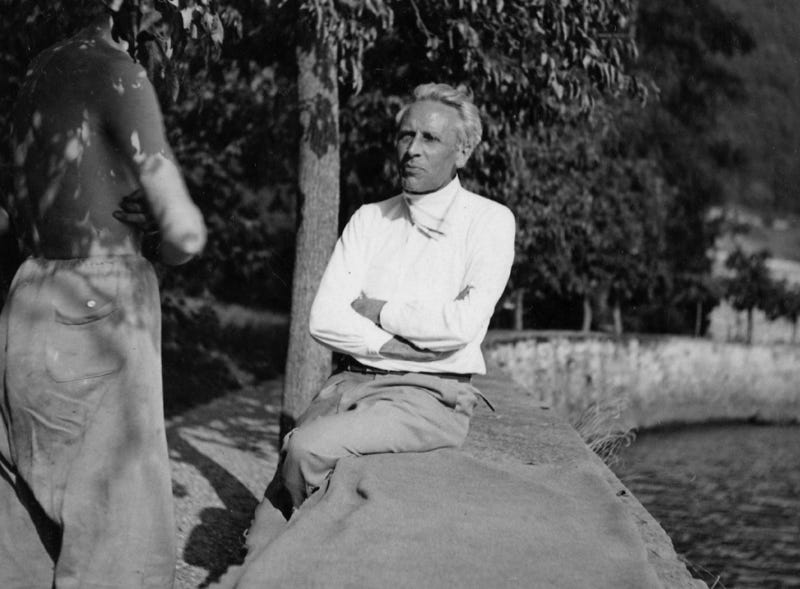

“I can say that this completely forgotten figure was reintroduced into the world of the German spirit by me.”, Manfred Schlößer, Karl Wolfskehl: Leben und Werk in Dokumenten. Darmstadt: Agora Verlag, 1969. From Michael Hollington: https://journals.openedition.org/babel/2770?lang=en
From personal letters by Klages to Rudolf Bode, as cited by Nitzan Lebovic in The Philosophy of Life and Death.
Ludwig Laistner (1845–1896), poet & mythologist; Wilhelm Mannhardt (1831-1880), mythologist & scholar; Heino Pfannenschmid (1828-1906), folklorist; Erwin Rohde (1845-1898), philologist and author of Psyche (1893). The current of research that Klages is alluding to pertains to the study of ancient religion and folklore, exemplified in the preceding Romantic period by the Grimm Brothers. See On Cosmogonic Eros for further discussion of their work and relevance to Bachofen.
Klages frequently opts to use “seele”, soul, where Germans of this period would typically use the related “psyche”, i.e., “seelenkunde” as opposed to “psychologie”. See his essay titled Goethe als Seelenforscher, “Goethe as Psychologist”. To Klages psychology was, properly understood, the study of soul—and psyche had already became inappropriately associated with the mind. In general, the basis of German psychology as found in the interpretation of the myths and symbols of antiquity should be well-noted here.
Ethnologists Lewis Henry Morgan (1818–1881), Maksim Kovalevsky (1851–1916), and Sir John Lubbock (1834–1913). Each are discussed in On Cosmogonic Eros.
Peter Kropotkin (1842-1921), anarchist philosopher and geographer.
This sentence should serve as a correction to any who assume that Klages, or indeed many other proponents of Bachofen, are entirely hostile to any “masculine principle”. As the later comment on Geist “possessing the day-side of Life” shows, Klages believed the masculine/paternal symbol had its respectable place in primordial man, and it is only that Geist has uniquely dominated this side of life. As Klages remarks elsewhere on polarity: “If one separates one of these limbs from the other, the world is destroyed.” (SW 3, 390)—and that is precisely what Geist has achieved.
Less idiomatically, “a millennia of plaster”, which indicates that the primordial content has been painted over in thick muck over and over again throughout Western history.
Schuler died unexpectedly at the age of 53 on April 8, 1923 from surgical complications during a tumor removal. Klages took personal responsibility for Schuler’s Nachlass, and published it in 1940.
Phaedro, 69c. In essence, there are many who claim an association with the cult, but few are genuine “true believers”, enraptured and devoted Bacchoi. To be sure, Klages considered himself one of the few.
Neunmalweise, related to neungescheid or neunmalklug—a know-it-all, a smart alec, or more plainly someone who acts far smarter than they actually are.
Klages here paraphrases from Nietzsche’s Thus Spoke Zarathustra the section “On the Flies of the Market”, which is full of “solemn buffoons” engaging in marketable spectacles. In effect, he accuses his competitors with engaging in the mere monetization of Bachofen through public spectacle.