


Great Heathens is a series which details figures in recent history who, while typically not open and practicing pagans, were drawn in and contributed greatly to its worldview. The series details their lives, thoughts, and actions; and how they contrasted with the modern culture they lived in.
Our previous article highlighted Thomas Taylor, the self-avowed Platonist and singularly crucial revivalist & translator of troves of ancient works.

This article returns to the Romantics, reflecting on the life and works of a young man whose tragic life gave birth to Romanticism itself: Novalis.


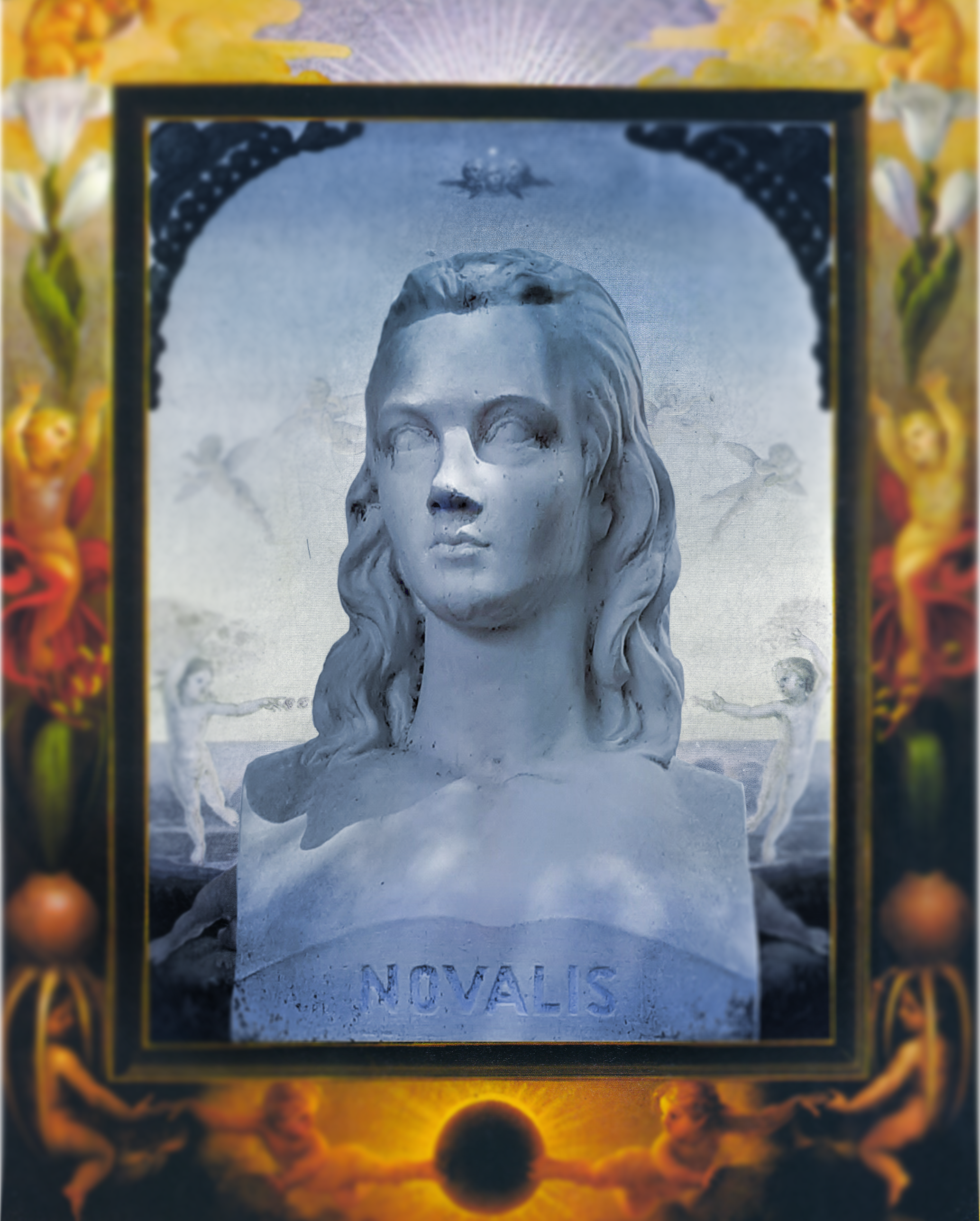
No longer was the Light the abode of the gods, and the heavenly token of their presence: they cast over them the veil of the Night. The Night became the mighty womb of revelations; into it the gods went back, and fell asleep, to go abroad in new and more glorious shapes over the transfigured world.
—Novalis, Hymns to the Night, V. (Trans. George MacDonald)
It bears repeating that this series, and particularly the daring act to include a man such as Novalis within its corpus, does not necessarily seek to itemize those who have openly professed their worship of the old gods, whatever the consequences may be. Some individuals certainly do belong to this category, such as Taylor and Klages, who made no attempt to conceal their devotion. Others either would unambiguously reject such a charge, and the remainder still would not even be able to comprehend the accusation in the first place. What this series illustrates, rather, is in fact a centuries-long process of possession, wherein long-forgotten forces first murmur underneath the protective cold steel of the Christian cuirass—patiently probing and interrogating weaknesses for a way out. The first Great Heathens saw themselves as nothing short of pious men of the cross, entertaining no possibility that their expressions would be considered something so hostile and alien to their world. Nevertheless, the drumbeat of the dithyramb surged them onwards, and the protective armor was soon cast off for light feet. With new generations came greater pace and intensity—the sound grows and reverberates still louder with each progression, thyrsus-twirlers soon leap from their slumber and dance on their toes about a burning pyre, cymbals clash and auloi awaken, to the gods are old words chanted, the glimmering dagger is raised into the air of the night—and then it all vanishes, at an instant. What follows is only a deafening, crushing, silence. Whence? Whither?
In his life and thereafter, Novalis was accused of many things—a mystic, Schwärmerei1—but never a heathen. In fact, his most controversial episode came during the posthumous publication of his Die Christenheit oder Europa which, tellingly, sparked a seriously problematic rumor that he died a Catholic.2 The last words in his writings, a scramble of his final poetic works as he felt death nearing, likewise leave little ambiguity: “All we call chance is ordered by God. Did not Christ Himself see the inexpressible grief of His mother? He knows what we feel when our sorrows react on those we love.” … “Courage strengthens. God’s will be done—not mine.”3 Furthermore, it was his Hymns to the Night that became his most popular work, which sought to illustrate death as the Romantic fulfillment and meaning of life—a fact mediated by Christ.
Nevertheless, the fact that Novalis was unquestionably a Christian—too, one with a deep and intimate relationship to the meaning therein—does not forbid us from including him at the earliest, faintest, days of the drum-procession. The fact that no one to date (as far as we can tell) has made the claim merely grants us the opportunity for originality. For beyond raising the same panegyric eulogy to the gods that Schiller did in coloring “the North-wind’s piercing breath”4, Novalis’ philosophy and works unfold in a manner that appear to have little to do with the ironclad Herrnhuter Pietism of his setting. Whereas Taylor the Platonist sometimes expresses himself in a flavor that still feels Christian, Novalis the Christian often sinks into the night-world of a Romantic heathen: his foremost mission was to be like the earth-diver Faust, to touch the key upon the glowing tripod in the dark and formless realm of the Mothers and bring back with him the essence of Beauty. His view of the world was of a fundamentally magical one: pulsing with rich vitality and the deepest of meaning, in which the barriers between “object” and “observer” were melted away in pursuit of a magicoreligious communion with the seen and the unseen.
He would not be the first nor the last Christian to conceive of it as such, though he was some five-hundred years apart from Meister Eckhart. But this was a new world which Novalis had invented for himself—and what a bounty bestowed upon the whole of German Romanticism thereafter! Only a life abounding with such promise and tragedy as his could generate such a world, a life such as his. In addition to this, his proximity to and influence on the more heathen strains of both German idealism and the nature of poetry itself—as it will be shown—have been generally overlooked by all forms of scholarship. We begin such an argument for the case here.
“Novalis” is simply the since-immortalized pen name of the man known as Georg Philipp Friedrich Freiherr von Hardenberg (5/2/1772—3/25/1801), a typically excessive name for a German aristocrat. Interestingly, and we do not know if he was aware of the fact, the pen name of his choice perfectly encapsulates the two lives that tore the mortal man in two on many occasions. He pulled the name from an ancestral branch of the Hardenberg line, and thus declared a dedication to his family and his lineage, which throughout his life he nobly submitted himself to even at the cost of his own desires. On the other hand, the name itself, “de Novali”, referred to those pioneers who “cleared new land”, setting out into the uncharted and leaving behind a path for safe travel. This grand contradiction split him right down the axis of his spine until the day of his death: true to his duties to his family and its wealthy salt-mines, and simultaneously, yearning for poetry and philosophy, a journey into a far more beautiful world than the one he was obligated to remain in. Yet this was not a yearning for the far-beyond or the undead, but for the possibilities of the immediate and visible universe. His dreams entailed a poetic and ascetic vision of the world which, for unknowable reasons, seemed to be crushed right before the moment of their fulfillment by the fact of wakefulness.
For much of his early life, he was privileged to the finest and most well-rounded education available in Germany through the connections of his family. At a young age, he was passed to his uncle for education, the Landkomtur von Hardenberg, a commander of Teutonic Knights in Brunswick; a change necessitated by, allegedly, the young Friedrich's falling-out with his father after he intensely argued with a Moravian pastor charged with tutoring him on theological matters. The patronage of his uncle greatly expanded his studies—Latin, Greek, mathematics, chemistry, politics, theology, law, literature—even though his interests and inclinations often harshly conflicted with those of his family, at a young age it was evident to all that the young man was tremendously gifted, and destined to be a genius:
Genius is often accused of superficiality and caprice, of preferring pleasurable to graver studies, of living in theories and abhorring practical matters. But this was not the case with Hardenberg. He was determined to study everything thoroughly and deeply, and to investigate every subject of human knowledge. Joined to this, he gave diligent heed to practical life, never shirking any detail, however irksome. In addition, his heart was open to impressions of all that nature, friendship, or love can offer; and while he labored to develop his mind, he never ignored the claims on his affections, and gauged clearly the hearts and powers of all around him.5


Indispensable as his early upbringing was, Friedrich would not fully bloom until the years of his independence at university, a freedom-in-struggling which he long desired. He was first sent to Jena in 1790 in pursuit of an education in law, as his father and uncle both agreed to rearing him for a promising career as a public official. True to his family’s wishes, the 18-year-old took to these studies with seriousness and intensity; yet, they did not satisfy his innermost desires. In more extracurricular activities, there he met two figures crucial to the formation of his worldview: the philosopher and reviver of Kantianism Karl Reinhold, and the great ally of Goethe, Friedrich Schiller. The latter became a close friend, or rather a venerated hero, of the young Hardenberg. When Schiller fell gravely ill from his chronic tuberculosis in 1791, it was he who helped nurse Schiller back to full health. In these days, Schiller convinced Friedrich to mitigate distractions such as attending his lectures on history, and return to the duties he was sent to Jena in the first place for. Even still, his first-ever published poem appeared just months later, dedicated to Schiller, and titled Klagen eines Jünglings (Complaints of a [Sensitive] Young Man). His father took notice of the distractions, and pulled him from Jena to instead study in Leipzig.
Yet fate carried him onwards, and it was here that he met his lifelong friend Friedrich Schlegel. Schlegel was a militant Hellenist and an advocate of a new mythology for Europe, ideas which certainly left an impression on Hardenberg, and in significant ways which must be returned to later. Quiet distractions towards philosophy and aesthetics soon became a second life, and the young man soon found himself frequenting social events, smothered in work on mathematics, chemistry, and philosophy (but not law), drowning in debt, and worst of all, struggling romantically. Following this was an episode of archetypically overdramatic youth—which some readers may relate to—where Friedrich wrote to his father that his only saving grace was to be found in a life as an infantryman:
I need discipline, and shall have to educate myself all my life. A character such as mine needs contact with actuality. A narrow circle stifles me. I require the incitements of duty to my fatherland; I must learn to bear blame, and be led by honor. The subordination, order, and monotony of a soldier’s life will be very helpful to me. My romantic tendency will be corrected by the practical, unromantic duties of my life. As to annoyances, I can live them down. I should be no son of yours if any fear of death held me back. I have an indifference to life which will seem to you paradoxical. I am convinced that many other losses are far more grievous. Life is not a goal, only a means; and when one passes from this planet one leaves behind little which one can regret.6
Thankfully, his uncle and father ignored the phase, and he continued and finally completed his law studies in Wittenberg in 1794. The period between here and 1797 would have been otherwise unnoteworthy days of family business, had it not been for one such business trip to Grüningen in 1795. There he was smitten by Sophie von Kühn, only twelve years old at the time, yet described as “possessing the judgement of an adult woman, joined by the attraction and animation of youth—beauty, wit, and excellence”.7 His love for the young Sophie was lit like a sacred flame; the satisfaction of his family that he was finally taking well to business matters overlooked the fact that these happy, attentive years were but for a proximity to her, and around her thirteenth birthday, the two became secretly engaged. Yet the dreams Friedrich had of a life and warm home with the girl were dashed in the spring of 1797, when young Sophie began to decline from the white death—tuberculosis. Despite a litany of prayers and hopes of her lover to the contrary, she died on March 19th, at the age of 15.


Friedrich was utterly devastated. Yet Fate’s cold hand was still not done with him, for just a few weeks later upon returning home from mourning at his Sophie’s grave on Easter Sunday, he was informed of the death of his dear brother Erasmus. Somehow, and here we must remark further on his exceptional character, these dark days did not end the man, now 25 years old. If anything, the life of Hardenberg had ended, and that of Novalis was born:8
It is a better-sweet remark, that misfortune increases our appreciation of friendship, or appears to increase it, because it arouses a greater demonstration of it. The joy of calm possession is unobserved; but in the feeling of loss the soul realizes to the fullest extent the value of the departed happiness. My love for Sophie seems increased by her death, and my appreciation of friendship is much keener. […] Now I must throw myself into the future, and live in the belief of God and immortality. It will be very difficult for me to cut myself off entirely from this world, which I studied with such devotion; it will cost me many a long hour to accomplish; but I know that a man has an inherent power, which, under given circumstances, can develop an unheard-of energy.
You would be sorry for me, if you knew the horrors of revolt through which I have passed. I do not deny that I most dread the fossilizing of my heart. By nature I was weak, but by degrees my understanding strengthened at the expense of my heart. Sophie restored my heart to its fortified throne. […]
I will devote myself to thoughts of the unseen world and until my death, which cannot be far off, I will seek comfort with a few friends and in devotion to my duties.9
It was a rather auspicious letter to his dear friend Just. The next years would see from him a frenzy of literary productivity; and indeed, death was not far off. Immediately after the death of Sophie, he produced Hymns to the Night—an uncontested work of art in its domain, which seeks to strike out an understanding of death. Its Christian significance is immediate, particularly in the fifth Hymn, where Christ restores the world after the tragic departure of the pagan gods (as quoted in this article’s introduction); it continues: “Since then, long ages have flowed past, and in splendor ever-increasing have bestirred thy new creation, and thousands have, out of pangs and tortures, followed thee, filled with faith and longing and truth, and are walking about with thee and the heavenly virgin in the kingdom of Love, minister in the temple of heavenly Death, and forever thine.” Yet another aspect of greater importance must be noted, in that Novalis introduces for the first time a typically Romantic union-of-opposites between life and death. He had already toyed with the concept in earlier works,10 but it is here where the poetic formulation is finally given the breath of a Muse, and in multiple places. Night is contrasted with light, death with life, finite with the infinite, seen with the unseen, outer with the inner. It is Novalis who, for the first time, illustrates the connection between these concepts without crushing them under the weight of monism:
I feel the flow of
Death's youth-giving flood;
To balsam and æther, it
Changes my blood!
I live all the daytime
In faith and in might:
And in holy rapture
I die every night.11
At roughly the same time, Novalis began to work on what he intended to be his life’s work: Heinrich von Ofterdingen. On the surface it seems to resemble a medieval romance, but it in fact has much more in common with the second part of Goethe’s Faust, which would not be finished for another 30 years. In fact, Novalis had in part created it as a response to Goethe’s Wilhelm Meister’s Apprenticeship, which he saw as a crudely atheistic piece in which economic prudence overcame poetic vision. Yet like Faust II, Novalis’ characters explore the depths of his soul in winding and shifting fairytales. Heinrich is dissolved into his dreams of the blue flower, and in these visions meets characters such as Eros, Fable, Perseus—merchants, crusaders, hermits—each serves their role in a tale in which Novalis, in essence, lays out a multitude of worlds for the reader. We will return to its significance later.
The boy lay tossing on his bed, and thought of the stranger and his talk. “It is not the treasures,” he said to himself, “that have stirred in me such an unspeakable longing; I care not for wealth and riches. But that blue flower I do long to see; it haunts me and I can think and dream of nothing else.”12
As vibrant as these works are, what relation do they have to the underlying thread, whereby we may assert a contribution to pagan thinking through these overtly Christian works? The first step of our analysis shall be reserved for an inquiry into the newfound poetic expression for Novalis following those tragic days. Poetry, for Novalis, was principally a search for meaning—meaning to be uncovered and expressed precisely in the format of Schlegel’s new mythos. His contemporary world could provide bits of philosophy, mathematics, and certainly it was adept in natural sciences, but the one realm where it failed to provided anything of worth was poetry. In this field, the world Novalis lived in seemed locked in a stasis, bound up in an Imperial disciplined coldness. Therefore, his search began the ritual which became so familiar to the coming Romantics: a resurrection of the past so that it may serve as a pliable mold for a new vision of and for the world. And whereas the Hellenists and Neoclassicists of his day sought to summon the image of beautiful Helen, Novalis looked instead to medieval romance. The historical analysis of Novalis has mostly ceased here, debating the extent to which he may be considered a mystical Catholic or a true Protestant. Yet if we inquire more into the nature of poetry and why Novalis was drawn to it, we discover something subtly different.
In 1797, a book of unknown authorship was penned titled The Oldest Systematic Program of German Idealism, and it would not be rediscovered until 1913. Hegel’s handwriting exists on pages of the manuscript, though other scholars believe the author to be Schelling or Hölderlin.13 Interestingly, it was this very trio that are said to have, in their youthful days, planted a tree to the French Revolution and danced around it chanting La Marseillaise.14 All three personally knew and drew inspiration from the young Novalis, but in regards to Novalis himself and his poetry, the author essentially adopts wholesale a fundamentally Novalian worldview. In presents the need, as will be echoed again and again all the way until the 20th Century, to unify the day-consciousness and night-sensuality into one worldview. Reason, enlightenment, and progress belong to the politics and morality of the day, but mythology, meaning, and poetry may only be located in the night:
At the same time, we hear so often that the great multitude must have a sensual religion. Not only the great multitude, also the philosopher needs it. Monotheism of reason and of the heart, polytheism of imagination and of art, this is what we need!
First of all, I shall speak here of an idea which, as far as I know, as far as I know, has not yet come to mind - we must have a new mythology, but this mythology must be in the service of ideas, it must become a mythology of reason.
Mythology, by definition, is a procession of a multitude of powers. Reason strives towards a single intelligible reality, such as an objective morality, but poetry and myth suffers tremendously under such a monistic catechism. How does one symbolize the ineffable singular essence of reality? Poets, to the contrary, are born to loosen our limbs under such constraints. They sink into the natural world and commune with a plurality of divinities—some shine, some cast shadows; many love, others wage war. A poet conjures up the genius loci of every place of reality he touches, allowing it to boast or whisper for its short allotted moment. Whether the poet’s gods be a muse, demons and angels, murmuring springs, the seasons, the fates, saints or heroes, Christ or Dionysus, the Palace of Agamemnon or the Imperial Court, he necessarily engages in a light-hearted revolt against The One in veneration of the since-neglected many. Such is evident even in the works of the great Christian poets to whom Novalis is compared—Milton, Dante, and Solomon. Yet in his own works, who does he task to make their grand procession before the words of the storyteller? He says: “The stars and the spirits of nature, following in glittering ranks”.15


If the reader is unsatisfied with the argument made here, he must at least understand that such a conception was very much “in the air” in this period, enduring as a central pillar of German Romanticism. Herder had already promoted the use of ancient myth and symbolism in poetry to provoke “a completely new mythology” for Germany in the 1760s, convincing Germans for the first time to accept inspiration from the heathen.16 Schiller’s Gods of Greece would come in 1788, lamenting the loss of the old gods and calling for their rebirth—“Tomorrow to receive new life, she digs her proper grave to-day".17 In 1791 came Moritz’ Götterlehre, where he intimately links poetic imagination and ancient myth.18 Schlegel too, in 1800, would write in the Athenaeum: “We have no mythology. But I add, we are close to obtaining one…”19 Or consider a third Jena Frühromantiker in Schelling, who wrote in The Philosophy of Art (1803): “Mythology is the necessary condition and the primary subject matter of all art.”—and furthermore, “This contradiction [between particular and absolute] is resolved only in the gods, which themselves can possess no independent, truly objective existence except in their complete development into a world of their own and into a whole of poetry, which is called mythology.”20 And finally, most clearly in the Great Heathen himself—Goethe—in a letter to Jacobi: “As poet and artist I am a polytheist, and as natural scientist, a pantheist.”21 This strain, so important to the German imagination, is what Nietzsche later championed as the great strength of polytheism: “In polytheism man's free-thinking and many-sided thinking had a prototype set up: the power to create for himself new and individual eyes, always newer and more individualized: so that these are no eternal horizons and perspectives.”22
For all of these thinkers—except perhaps for Goethe, yet including Novalis—“the gods” are formulated as something which are not necessarily revealed from nature, but rather interpreted, created, or willed upon nature by the creative imagination of the poet. This is the basis of what would later be called “magical idealism”, and Novalis was center stage in its earliest formulation. Magic, for Novalis, was “the art of using the sense-world at will”, and the magical idealist was he who could make his thoughts outer—to realize the ideal—and make outer things inner—to idealize the real. Or, as he would put into a more digestible aphorism that would later be found in the front pages of Klages’ books, “the external is the internal raised to a state of mystery”. This poetic vision of the world, as he says, is the very essence of what it means to be a Romantic:
The world must be romanticized. In this way one rediscovers its original meaning. Romanticizing is nothing but a qualitative raising to a higher power. In this operation the lower self is identified with a better self. […] By giving the common a higher sense, the ordinary a mysterious aspect, the known the dignity of the unknown, the finite an infinite appearance, I romanticize it—and the reverse operation for the higher, the unknown, the mystical, the infinite.23
Indeed, the true Romantic is—in a sense—a conjurer, a mystic, a theurgist; therein lies all of its fruits and follies. Yet what makes Novalis unique among this procession is in fact his refusal to partition the mind and body into separative facultative properties, whereby one is raised for one task and the other for a separate one. The notion that poetry must be irrational, or that reason must be unimaginative, was for him itself an irrational and unimaginative view—if this could break the distinction, then surely too could we find in the world something that is both imaginative and reasonable. By bridging the ideal and the real into one mutually accessible world, Novalis is able to produce precisely the new mythos that his contemporaries had been searching for—this was the crowning achievement of Ofterdingen and all of its rich symbolism, the first novel of its kind in German for hundreds of years. In his attempts to unify the one with the many through creative imagination, the poet-philosopher in Novalis therefore has far much more in agreement with Spinoza than Fichte or Kant.24 Nevertheless, it remains clear to us that the novelty of this worldview is deservedly placed at the beginning of Romanticism—the new mythology—more than it is within medieval Christendom.
In the middle of his extraordinarily productive and voluminous attempts to weave these things together at the turn of the 19th century—magical idealism, creative imagination, a new mythology in Ofterdingen—the cruelty of life would come for the 28-year-old once more. In August of 1800, he began to cough up blood and collapse in fatigue. The doctors of the time had diagnosed him, as they did with his brother Erasmus, with tuberculosis. Yet modern research has grown more confident on a diagnosis of cystic fibrosis, a recessive hereditary disorder that would explain the frail health of much of the Hardenberg family. Even as recently as 2012, the life expectancy of the illness hovered just under the age of 30. Yet despite being bedridden, he continued to work, and began to leave behind fragments and notes to lay out the framework of the remainder of Ofterdingen. Much of this was left to his friend and biographer Tieck, who provides us with a rough sketch of the remainder of the tale:
The author advanced no farther in the composition of this second part, which he called The Fulfilment, as he had called the first The Expectation, because all that was left to anticipation in the latter was explained and fulfilled in the former. […] To the poet nothing appears contradictory or strange; the riddles are solved for him; through the magic of the imagination he can link all ages and worlds; wonders disappear and everything transforms into wonder.
Much can be gleaned from this individual assessment of Tieck’s. But in place of that, and more specifically in relation to polytheism and Christianity, we will meditate on how Tieck tells us (through fragments and personal conversation) he intended to end the story, which proves to say far more than we are able:
He soon reaches that wonderful land in which air and water, flowers and animals, differ entirely from those of earthly nature. The poem at the same time changes in many places to a play. Men, beasts, plants, stones and stars, the elements, sounds, colors, meet like one family, act and converse like one race. Flowers and brutes converge concerning men. The world of fable is again visible; the real world is itself regarded as a fable. He finds the blue flower; it is Matilda, who sleeps and has the carbuncle. A little girl, their child, sits by a coffin, and renews his youth. This child is the primeval world, the close of the golden time.
Here the Christian religion is reconciled with the Heathen. The history of Orpheus, of Psyche, and others are sung.25
Novalis—Friedrich von Hardenberg—soon succumbed to his illness on March 25, 1801, at the young age of 28. The death of the eldest Hardenberg was a tremendous blow to the family; his father asked that no condolences be sent. Yet his death was also meaningful to those multitudes that the young genius had so well impressed over his short life. The span of his true intellectual career spanned but four meagre years between the death of Sophie and his own, yet in that short time he had made a number of remarkable achievements. With others such as Schlegel and Schelling in the Athenaeum, his writings therein in contribution to a new mythology gave birth to German Romanticism itself. And with those birth pangs he gave it its most cherished and sacred symbol—the blue flower. This rare, delicate, and beautiful flower—no man can have it, though he longs and desires and strives towards it with all of his being—it is trembling unrest, restless striving, inspiring and dreadful longing. As Carlyle put it: “being Poetry, the real object, passion and vocation of young Heinrich, which, through manifold adventures, exertions and sufferings, he is to seek and find.”26

Amor Fati & The Blue Flower

Heinrich was fated to hold the blue flower for but a moment until it vanished in an event of unspeakable tragedy, so goes the unfinished work of an author who succumbed to such a sorrowful fate as his own. Why, at all, do we then strive towards the unattainable? It is not possible, fruitless and pointless, non Plus Ultra. Yet we persist—why, what is the point?
As the tragic death of Sophie had greatly inspired Novalis to great works, the death of Novalis himself was of great inspiration and a source of unity to the Romantic circle he was a part of. No further iterations of the Athenaeum were published, its purpose now fulfilled: the spring-flower of German Romanticism was in full bloom, and its autumnal harvest was just a generation away. Yet it would be some time before Novalis, on the day of his death a rather underground figure, would become fully appreciated. It was his dear friends in Schlegel, Schelling, Just, and Tieck who would be responsible for compiling his hurried death-bed notes into a presentable worldview, and this took time.
There is one work, however, that was widely appreciated in German culture before his death: Hymns to the Night. Even though they in one place lament the passing of the old gods and the beautiful world they reigned in—“The gods vanished with their retinue… Nature stood alone and lifeless”—the Hymns became popular choices to be sung on Sundays across Germany, igniting a Protestant fervor that had not been felt since the days of Luther. His father long toiled with his son’s artistic exuberance, which he saw as little more than ungodly distractions. Yet upon hearing one beautiful hymn some time after the death of his son, which echoed so vibrantly about the vaults of the church, he rushed to the priest to inquire about its authorship. He asked, “Who wrote such a piece?” and heard in reply, “Your son did, Freiherr.”27
Into the bosom of the earth!
Out of the Light’s dominions!
Death’s pains are but the bursting forth
Of glad departures pinions!
Swift in the narrow little boat,
Swift to the heavenly shore we float!Blest be the everlasting Night,
And blest the endless slumber!
We are heated with the day too bright,
And withered up with cumber!
We’re weary of that life abroad:
Come, we will now go home to God!28
If Novalis was a Great Heathen, he was a remarkably and unquestionably Christian one. For on one hand he relied on those great ancients and their instruction of an immediate apprehension of the world for his vision of nature and of aesthetics—which drove his poetry and works to such beauty—yet on the other hand, he relied far more deeply on the care and promise of Christ to find Fulfillment, to find an understanding, of the unimaginable tragedy that had shadowed his short life. The reconciliation between the Christian and the Heathen that he died too soon to complete in Ofterdingen was therefore not merely in reference to art or to world-historical affairs, but to the innermost depths of himself. It was this very stress between the gods and the cross that produced the high art of the Renaissance, and this contradiction which tormented and inspired the minds of many Romantics to come. His early death only reinforces the fact of the matter, robbing us of the opportunity for a more beautiful, more meaningful, interpretation of his soul.
In either case, his contribution to the world is clear: his life, and only his, could serve as the birth pangs of the blue flower, and the whole of Romanticism with it. For this, every thought and idea to be nurtured by this womb is indebted to this, heathen or not, great man.

One who is excessively sentimental.
M.J. Hope, Novalis: His Life, Thoughts, and Works (1891). pp 24 - 25.
Schiller, Gods of Greece.
M.J. Hope, Novalis: His Life, Thoughts, and Works (1891). p 33.
M.J. Hope, Novalis: His Life, Thoughts, and Works (1891). p 18.
M.J. Hope, Novalis: His Life, Thoughts, and Works (1891). p 36.
The first publication where Friedrich used the name “Novalis” was Grains of Pollen in 1798, although he could have used it privately beforehand.
Letter from Novalis to Just, 29th March, 1797.
See Pollen §61: “Before abstraction all is one, but one as chaos; after abstraction, all is again united; but this union is free and independent, a self-determined reality. Out of a multitude a fellowship is born; in a meaningful world chaos is transfigured.”
The original and still-worthy English translation of Hymns belongs to George MacDonald. Read it here.
Opening passage of Ofterdingen.
Terry Pinkard, Hegel: A Biography, pp. 24–25.
We cite here the famous “Klingsor Procession” in Chapter 9 of Ofterdingen. It retains a special home in German culture and literary scholarship, but we leave this outside the scope of the article.
Herder, Johann Gottfried. "Vom neuern Gebrauch der Mythologie."
Schiller, Gods of Greece.
Moritz, Karl Philipp. Götterlehre oder mythologische Dichtungen der Alten. Berlin, 1791.
Schlegel, Friedrich. "Rede über die Mythologie."
Schelling, F. W. J. The Philosophy of Art. §38-39
Goethe, Letter to Friedrich Heinrich Jacobi, 6 Jan. 1813.
The Gay Science, §143.
Novalis, Logological Fragments I.
Novalis’ late writings deal intensively with Kant, Fichte, and Spinoza, whereby he formulates his own philosophy between Schelling’s idealism, Fichte’s Not-I, and Spinoza’s monism. This topic is far too vast and complex for the article at hand, but current scholarship exists for further reading (see here).
M.J. Hope, Novalis: His Life, Thoughts, and Works (1891). p 19.
Hymns to the Night.
I am so glad you have written this, Novalis and his insights ought to be heard by everyone who’s soul even approximates true sensitivity.
Thank you for introducing me to this author. Upon first reading of Hymns of the Night, I was struck by his poetic descriptions of the Mother and of Night, which to me as a Hindu, reminded me strongly of the Goddess Kali and of the Devi generally. From the description of her eyes, to her bosom, to her dark skin glittering with stars, to the 'new life' upon her neck which sounds like her necklace of skulls, she who 'gavest birth to the universe'... it's quite similar. Even her association with Death, which to Hindus is more active and fierce, but to Christians is obviously more gentle and sublime. It makes me think that the traditional heathen/pagan worldview affirmed the deep symbological and magical world that all humans once lived and breathed and shared, and which several times has burst forth even in Abrahamic societies.