


The following is part two of a three-part series detailing a theory of religious experience, involving commentary on the Greeks, Nietzsche, and others on the principle of “ecstasy” and the divine gifts of madness. The fundamentally irrational nature of religious experience will be illustrated, as well as how to practically approach it today.
See part one:


Stop feeling oneself as this phantastic ego! Learn gradually to discard the supposed individual! Discover the fallacies of the ego! Recognize egoism as fallacy! The opposite is not to be understood as altruism! This would be love of other supposed individuals! No! Get beyond ‘myself’ and ‘yourself’! Experience cosmically!
—Nietzsche's Complete Works, Critical Study Edition, Book 9, Ch. 11, §7.
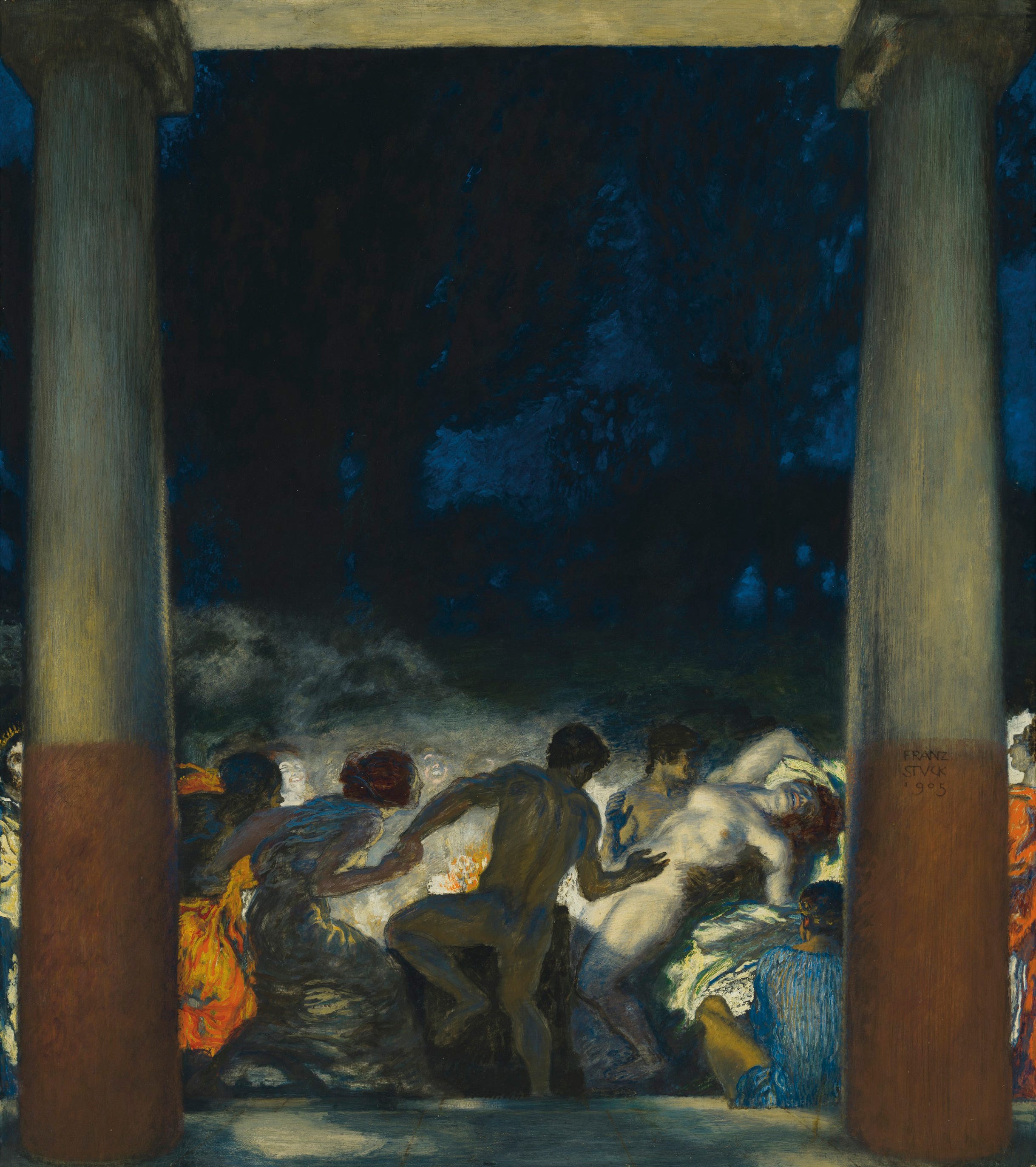
Our previous installment of this series introduced the concept of ecstasy—to be outside of oneself—through the ritualistic meaning of the tragic mask. The historical use of the mask in tragedy to essentially nullify the face and persona of the actor, inviting gods and souls to possess his body for the performance, gives us an incredibly rich insight into the essence of man's primordial religion. Through this, ecstasy—not “morality”, not “tradition”, not “reason”—presents itself as the central element of religious experience. But what exactly is ecstatic experience, and what is the point in illustrating its existence? For this, we turn to the rediscovery of ecstasy in the 19th and 20th centuries, from which a number of remarkable thinkers will serve as our guide. We begin with a piece that may be familiar to readers of this journal:
The German youths who celebrated the solstice with sheep-sacrifices were not the first to hear the rustling in the primeval forest of the unconsciousness [Rauschen im Urwald des Unbewußten]. They were anticipated by Nietzsche, Schuler, Stefan George, and Ludwig Klages. The literary tradition of the Rhineland and the country south of the Main has a classical stamp that cannot easily be got rid of; every interpretation of intoxication and exuberance [Rausch und Überschwang] is apt to be taken back to classical models, to Dionysus, to the puer aeternus and the cosmogonic Eros.
—Jung, Wotan, Neue Schweizer Rundschau (March, 1936)
So begins the 1936 edition of Carl Jung’s essay on Wotan, in which he argues that the movements of German culture and history in the preceding decades could only be explained by the psychic nearness of a god. In his view this god was not Dionysus as many had claimed, but Germany’s own Wotan. Yet the essay is interesting far beyond its typical use for matters of comparative mythology, in fact, the most interesting detail is what is already familiar to his audience: the German fascination with Dionysus. The youth were indeed sacrificing animals to the gods, and the heathen Kosmikers1 Jung names directly—Schuler, George, and Klages—held immense sway over the then-stirring hearts of Germany. All of this is evident in the surging movements of the late 19th and early 20th centuries—Lebensreform, Jugendbewegung, Kulturkritik, to note a few—which staked their lives on the complete upturning of society as it was known. Every artifice of contemporary society was to be judged and recoiled against, particularly those inextricably attached to the stifling, total state of Prussia’s Germany.
Thus Dionysus—called by a few of his many masks as “the Liberator” (Ἐλευθερεως), “the Cleanser” (Καθαίρως), “the Releaser” (Λὐσιος)—was implicitly, and often explicitly, understood as the patron of these movements which sought to, at a fundamental level, transgress. While this transgression certainly included the hedonism of the coming Weimar period, it must also necessarily include the transgression of naval treaties, international law, and all things up to and beyond the established moral order of the world itself. No construct of man was safe from the enraptured disciples of Dionysus who, much like the Bacchantes of old, took to the wilderness with instruments to sing the songs of rebellion.

Though the description of the upheaval thus far is certainly true to its essence, it is limited in its scope, and has in fact led us into a misconception. We would be in error to illustrate Dionysus and his disciples as simply “that which rebels against norms”; certainly, the horse thief nor the disgruntled teen have hardly anything to do with the rapturous ecstasy of Bromius. A few questions thus remain to be answered: which norms were being rebelled against, and why? What is the nature or mechanism of this rebellion, and, most importantly, what precisely did these initiates seek to gain from it? To answer, we need but one word, and it was one that found its way out the lips of Germans very often in these days: Rausch.
The Deutsches Wörterbuch (1854) of the Grimm brothers provides a lengthy and helpful investigation into the term and its various usages2. It the most literal sense it is translated into “intoxication”, and this is verified by a number of loanwords which allude to the state of half-drunkenness, or “being buzzed” in modern slang: Ruus in Scandinavian tongue, Roes in Dutch, or, more familiarly, arousal in English. It may additionally refer to stirring, rustling, or commotion, and the double-edged meaning allows for interesting wordplay in pieces which attempt to describe this state, for example, the experience of the 1870 Siege of Strasbourg as illustrated by Friedrich Ratzel3:
In reality, every one of us is a tree within the forest of his Volk; this is how it is, will be and must be. We live with it, we die with it, we harvest the fruits of its victories and pay for its mistakes, when exuberance and recklessness bring it to fall. Today, I can feel how we were intoxicated, and how all of us, people of this Volk who felt unique and lonely, rustled along [rauschten mit], just as a neighbour rakes his leaves.
—Ratzel, Glücksinseln und Träume (1905), p. 120.
By the mid-19th, as we are told by the Grimms, Rausch was undergoing a radical transformation in meaning. The state of drunkenness was liberated from its original alcoholic and drug-induced connotations and applied to the whole of life and experience, a Rausch of “spiritual intoxication, and inner rapture—even to the point of self-oblivion”. In other words, Rausch had become a “cosmic” ecstasy, a union with the world born from the destruction of the ego. We learn that the objective of Rausch was not the simple experience of pleasure, but religious experience of the highest order, and an assault on all things that stood in the way of it—ethics, technology, progress, history, and rationalism—these things must be treated as the restrictive chains of the soul.4
The distinction from popular misconceptions must be understood: Rausch is not the liberation of the individual from society or any such elevation of the ego above it; in fact, in such experiences the individual is, for a moment, utterly destroyed. We would be keen to remind ourselves that Dionysus is not merely associated with revelry and exuberance, but terror and bloodshed, too, the frenzied consumption of raw flesh and the “rendering of men”. Dionysus, called two-natured (διφυῆ) in Orphic Hymns5, reigned over both the fullness of life and its violent, tragic end; life lived to this fullest extent, enraptured in the state of Rausch, can only lead to tragedy. Yet this destruction, as it is for the two-natured god, immediately provides rebirth: the soul, finally broken free of its mental chains, is in this fleeting moment wedded in a cosmic union with the world. From here flows the beauty and vitality of meaningful life, tragic life, as it was put forth by Nietzsche:
Dionysian art, too, seeks to convince us of the eternal joy of existence: only we are to seek this joy not in phenomena, but behind phenomena. We are to perceive how all that comes into being must be ready for a sorrowful end; we are compelled to look into the terrors of individual existence—yet we are not to become torpid: a metaphysical comfort tears us momentarily from the bustle of the transforming figures. We are really for brief moments Primordial Being itself, and feel its indomitable desire for being and joy in existence; the struggle, the pain, the destruction of phenomena, now appear to us as something necessary, considering the surplus of innumerable forms of existence which throng and push one another into life, considering the exuberant fertility of the universal will. We are pierced by the maddening sting of these pains at the very moment when we have become, as it were, one with the immeasurable primordial joy in existence, and when we anticipate, in Dionysian Rausch, the indestructibility and eternity of this joy. In spite of fear and pity, we are the happy living beings, not as individuals, but as the one living being, with whose procreative joy we are blended.
—The Birth of Tragedy (1872), §17.
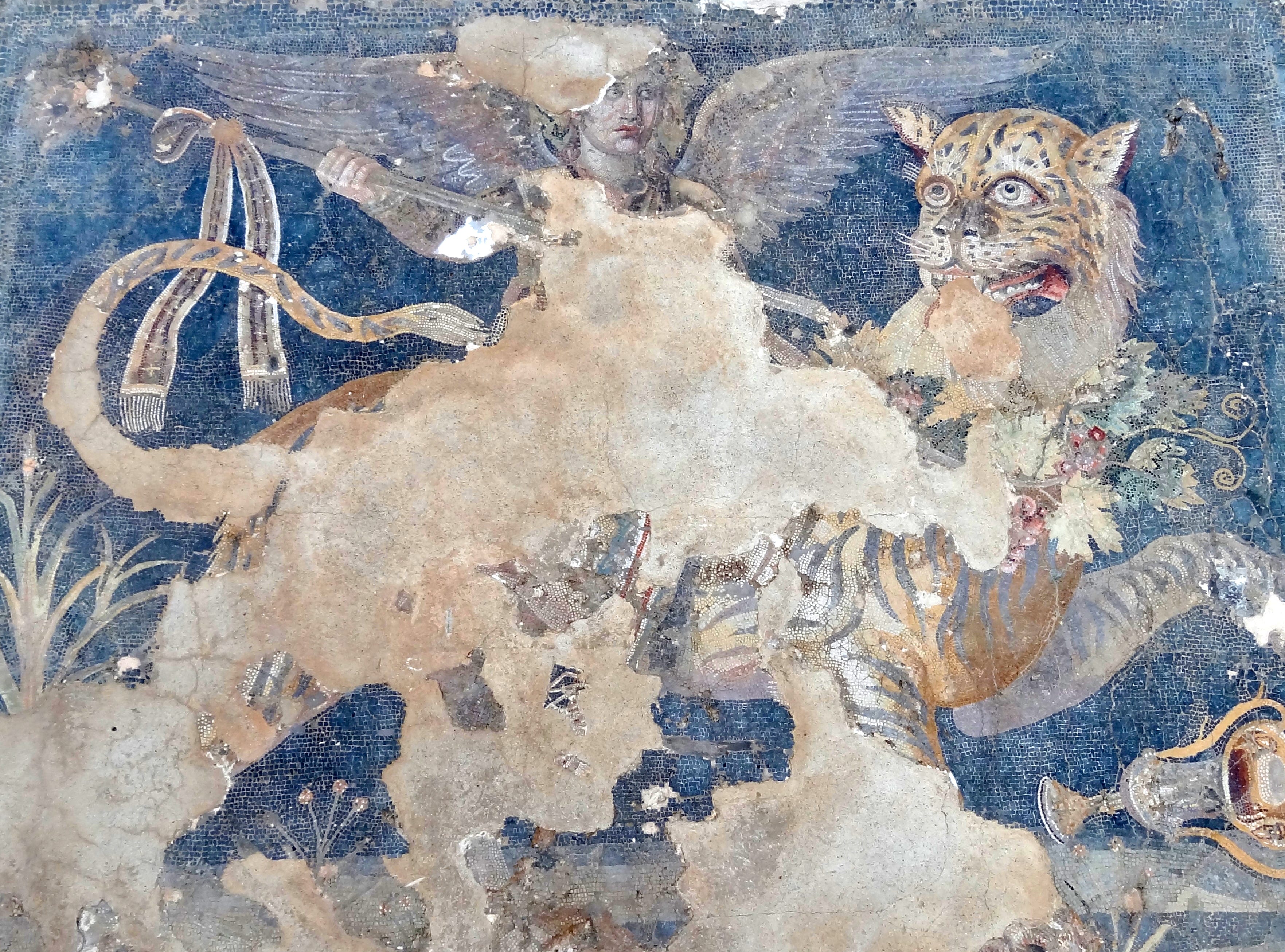
Rausch was a very familiar concept to Nietzsche, which he described as the fundamental prerequisite for any and all creative activity—“the outcome of all great desires”. It is arguably through Nietzsche that the concept of a “cosmic Rausch”, an ecstatic union with the world, is first bestowed to the wider public. In his writings, he is clear that he does not conceive of Rausch to be limited to sex, drugs, and alcohol as it is today, but extends through the whole range of human emotion and activity. Any desire, any passionate activation of the will or of vital forces, comes from the state of ecstasy, be it love, warfare, poetry, or prophecy. All may be experienced ever more deeply in the revelry of Rausch:
The same applies to that ecstasy which is the outcome of all great desires, all strong passions; the ecstasy of the feast, of the arena, of the act of bravery, of victory, of all extreme action; the ecstasy of cruelty; the ecstasy of destruction; the ecstasy following upon certain meteorological influences, as for instance that of spring-time, or upon the use of narcotics; and finally the ecstasy of will, that ecstasy which results from accumulated and surging will-power.—The essential feature of ecstasy is the feeling of increased strength and abundance.
—Twilight of the Idols (1888), §8. “Concerning the Psychology of the Artist”
What precisely is the state of Rausch like when one delves into it? Necessarily, it is to “see through” the world, rather, to melt into it; to transgress all self-imposed and externally-imposed limits between man and the world, to experience the total whole of reality. And what is the root of all of these obstacles? The Logos, which in the polarly contrasted state of pure Reason, selects and brackets off portions of experience into “objects” and “things”, interrupting the flow of life and “abstaining” from the gluttony and intoxication of full experience. This should not, however, be interpreted as “the will to transgress” or the conscious decision to do so—there is nothing conscious about transgression, no choice involved—the forces of existence are in this state “stuffed into us” with or without our approval, resulting in the state of pure experience. Only here is the tragedy and meaning of existence not necessarily “understood”, but “felt”. In an unpublished fragment, Nietzsche explains through imagery where clear words may fail:
To us, and to nobody else, an all-encompassing gaze is allowed, above all beyond and ignoring any end. This gives us a feeling of enormous distance, but also of enormous emptiness... In contrast to this feeling is Rausch, that sense that the world as a whole has been stuffed into us, that our suffering is the bliss of being full beyond repletion. Likewise, time takes on the most novel forms when Rausch is at the controls. We all know Rausch, whether as music or as self-blinding enthusiasm; we know that the Rausch of tragedy is the cruelty of observation.
—Nachgelassene Fragmente (1884), p. 213.
However, in his later years, he came to be critical of a particular flavor of this now-popular conception of ecstasy in that it, in an assault against its own intended purpose, offered man yet another avenue of life-denying detachment6. Rausch had lost its way: rather than seeking a union between body and life, “ecstasists” of the day used the state of Rausch to find, invent, the self-deceptive morphine of a new “true self”, from which the barriers to this state could be externalized and blamed for all of the sufferings of life. Thus Rausch, still for Nietzsche the source of great inspiration and meaning, had come to merely provide man with yet another tool to lie to himself with. Indeed, much of the same is true for the New-Age “spiritualists” of today, who employ all of the revelry and liberation of Dionysus with a complete aversion to resultant terror and tragedy.
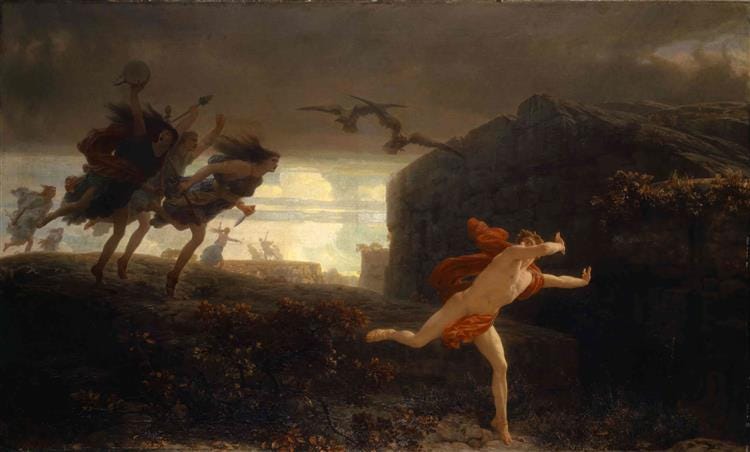
Not all of those who followed Nietzsche succumbed to the error of employing Rausch for life-denial. The guardianship of this concept would soon pass to the Kosmiker Ludwig Klages, who in no uncertain terms put naked, tragic life back into the center of German culture. He is sure to credit his teacher in his popular 1922 Vom Kosmogonischen Eros: “Nietzsche discusses Rausch as the ultimate Dionysian state of mind. Erotic, ecstatic, and cosmic at the same moment, this was the ‘life of the elements.’” Klages seems conscious of Nietzsche’s late turn against the ecstatics, offering a conception of ecstasy that does not see liberation as an escape or ego-construction, but as a deepening, or melting-into the world—a κατάβασις (katabasis), a brief journey into the underworld where the images and souls of the eternal now may be communed with. Additionally, he is sure to stress what the state of Rausch precisely is: the complete loss of the individual, and a union with the cosmos:
If ecstasy is removing the spirit from the soul, then it must also be: removing the self from the soul. This is compellingly confirmed for us by, among other things, language and, above all, the German language. Literally translated, ecstasy does not mean ‘to be carried away’, but ‘to be outside oneself’ (=outside the ego). Drunken or intoxicated individuals, whether through enthusiasm or as a consequence of narcotics, no longer ‘feel right in themselves’, but are ‘out of it’; are in danger of ‘forgetting themselves’; and, when sober, ‘come to themselves again’.
[...]We come across first of all in initiatory societies the following recurrent fact of the matter: mystical certainty derives from the experience of the ‘epopteia’, i.e. in the visionary intuition—the visionary intuition relates to the appearance of the deity (epiphany, parousia)—and this in turn takes place on the occasion of the symbolic representation of his death with the subsequent rebirth out of a ‘sacred marriage’. To anticipate the final conclusion: the initiate experiences the consecration of the fulfilment as he, himself deified, is wed to a god (communion, unio mystica, hierosgamos), and he unites himself with him as he sees him.
[...]For anyone who, in ecstasy, explodes the form of being a person, the world of facts in that very moment comes to an end, and before him or her there arises, with an all-suppressing power of reality: the world of images.
—Klages, Sämtliche Werke pp. 391-417 (transl. Paul Bishop, Ludwig Klages and the Philosophy of Life, 2018).
This is the experience of Rausch, to “experience cosmically”, the true meaning of that since thoroughly-bastardized conception of “ego-death”: the world of images, of souls. One ceases to observe things as particular concrete objects which may be managed, moralized, rationalized, or quantified in value—this city, that forest, her hair, these birds—and sees in to the world as a ceaseless and dynamic stream of souls. Such is the state of the preconscious mind, and therefore, the fertile soil of the furthest reaches of man’s primordial religion. His was not merely the religion of ethical commands or a linear movement between beginning and end, but the immediate nearness of gods and the reception of souls. To the extent that we—if only for a fleeting moment, never to come again—gaze into the nocturnal heavens and see not constellations, but the cosmos, we have become enraptured by something external to us into the state of Rausch; here, we have rediscovered the divine.

The shorthand name for the Munich Cosmic Circle, which included Ludwig Klages, Alfred Schuler, and others. It was most active between the 1890s and 1930s.
Ratzel was a German ethnologist best known for his concepts of biogeography and Lebensraum. He was shot through the ear at Strasbourg, never recovering hearing.
See Klages’ 1913 Mensch und Erde: “Like an all-devouring conflagration, ‘progress’ scours the earth, and the place that has fallen to its flames, will flourish nevermore, so long as man still survives. The animal- and plant-species cannot renew themselves, man’s native warmth of heart has gone, the inner springs that once nurtured the flourishing songs and sacred festivals are blocked, and there remains only a wretched and cold working day and the hollow show of noisy ‘entertainment.’ There can be no doubt: we are living in the era of the downfall of the soul.”
Orphic Hymn 30: “Κικλήσκω Διόνυσον ἐρίβρομον, εὐαστῆρα, // πρωτόγονον, διφυῆ, τρίγονον, Βακχεῖον ἄνακτα”. (I call Diónysos the loud-roarer! Who wails in revel! First-Born, two-natured, thrice-born, Vakkhic king…)
See Dawn (1881) §50: “Belief in Inebriation.—Those men who have moments of sublime ecstasy, and who, on ordinary occasions, on account of the contrast and the excessive wearing away of their nervous forces, usually feel miserable and desolate, come to consider such moments as the true manifestation of their real selves, of their “ego,” and their misery and dejection, on the other hand, as the effect of the “non-ego”. This is why they think of their environment, the age in which they live, and the whole world in which they have their being, with feelings of vindictiveness. This intoxication appears to them as their true life, their actual ego; and everywhere else they see only those who strive to oppose and prevent this intoxication, whether of an intellectual, moral, religious, or artistic nature.”
algo boost o algo
One thing I really appreciate about this piece is the pushback against the modern tendency to reduce ancient religion—especially the Greeks—to a kind of proto-scientific rationalism. There’s something important in recovering the fact that religious life, for them, was often immediate, affective, and at times overwhelming. That dimension does feel underrepresented in how we talk about both ancient and modern faith.
That said, I wonder if the pendulum swings a bit too far in equating the divine primarily with the irrational or ecstatic. A Pauline reading of Christian experience seems to preserve both inspiration and agency. In First Epistle to the Corinthians 14:32, Paul explicitly says “the spirits of the prophets are subject to the prophets,” which suggests that even in genuinely spiritual moments, the individual is not overtaken or displaced, but remains responsible and self-aware. Likewise, the “fruit of the Spirit” in Epistle to the Galatians includes self-control, which feels like an important counterpoint to the idea that divine encounter necessarily entails loss of control.
Personally, I don’t read this as a call to suppress emotional or ecstatic experience, nor to retreat into hyper-rationalism. Rather, it seems to point toward a kind of balance: that a person can be moved, inspired, even deeply affected, while still remaining in control—able to weigh what is heard, seen, and experienced against what is true, and then decide how to respond. In that sense, the presence of discernment doesn’t diminish the experience; it gives it form and direction.
So perhaps the distinction isn’t simply rational vs. irrational, but between different kinds of experience—those that overwhelm and fragment the self, and those that engage and transform it without erasing it. The ancient world may help us recover the reality of encounter, but the New Testament seems to insist that such encounters are not purely chaotic—they are also ordered, discernible, and participatory.
Curious how you’d reconcile that tension.