


The following is the last of a three-part series detailing a theory of religious experience, involving commentary on the Greeks, Nietzsche, and others on the principle of “ecstasy” and the divine gifts of madness. The fundamentally irrational nature of religious experience will be illustrated, as well as how to practically approach it today.
See parts one and two:


As the ancients testify, madness is superior to a sane mind, for one is only of human, but the other of divine origin.
—Plato, Phaedrus 244[a]
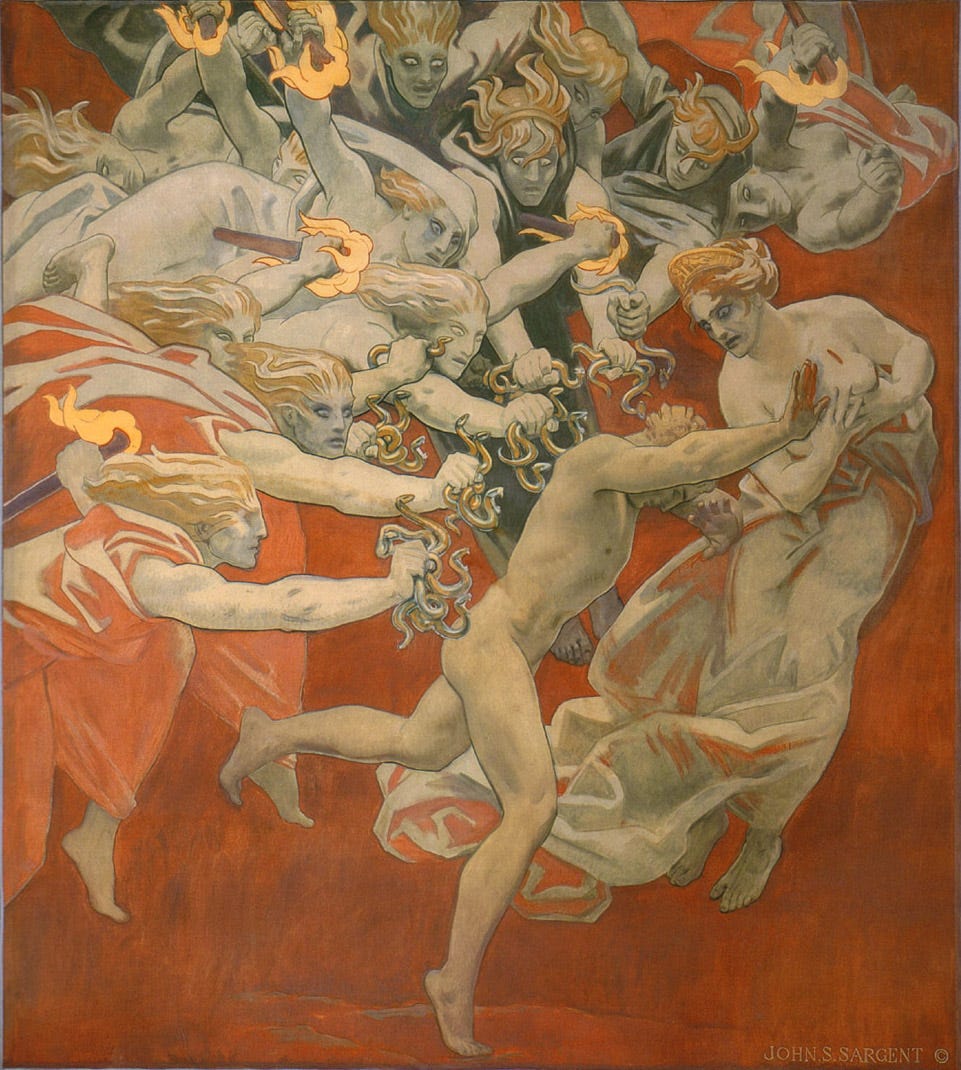
Today, as it was for millennia before, the word “philosophy”—particularly that of the Greeks—is synonymous with “reason”, “rationality”, “Logos”. To our age, it is but a backwards self-reflection, a self-justification, of the long and arduous triumph of intellectualism over barbarism. Progress, technology, democracy, the “uncovering of truth through rational dialogue”: it is these things which we place in the zygote of ancient Greece, from which we hail the birth of “Western Civilization”. Whether he is a saint, a salesman, or a scholar, all find themselves in the nature of their birth, wrapped as a child in the comforting bliss of the warm blanket of rational reassurance. Now a grown man, he works his deeds upon the world.
The truth of the matter—if we may appeal to reason—is that if Greek civilization itself was born and cultivated by word, it was not Logos, nor dialogue, but the dithyramb1: the uncontrollable, bursting state of exuberance and enthusiasm, where the words of the poet spill forth like honey and oil. Words which—as we are told by Socrates—nobody, not even the poet himself, can be said to actually understand the meaning of.2 Nonetheless, these were words to which men must dance to in wild processions, enraptured into a state of Rausch by fullness of wine-life. The tragedy, “ode of the goat-men”, was performed with the most sincere expressions of religious and ecstatic fervor long before the impiety of Socrates was put to trial, and even he was said to have participated in the Corybantic rites, howling and stepping in the orgiastic war-dance of armored Phrygians—as any young educated Athenian would.3 In truth, the Greek soul knew nothing of the type of rationalism we impose upon it today, not in its origins, and not even through the Platonists. It recognized technological devices as nifty and distracting toys for slaves, on other occasions it begged a chorus of gods and daimons for their understanding when a bridge was to be built over streams. True, we speak at length about the legends and stories of the Greeks, their pantheon of demons and personified natural forces (which no man would really believe in), and some thousand-years of rich rational dialogue—especially that which criticizes the former categories. Yet, evidently, we think comparatively little about Greek religious experience; how he, in the daily operations of his life, viewed his role in and relationship to a world in which the gods ceaselessly acted.
It has been the aim of this series to reemphasize this dimension of religiosity, the fundamentally irrational and preconscious aspects which, in the experience of divinity, the individual is thrown out of his typical and rational self. Merely uttering this word—irrational—throws off a series of alarms and check valves within the modern machine-mind, elucidating a response similar to that of towards evil itself. That which is not sufficiently rational can be safely thrown to the wayside, sure enough, but the appearance of something which is proudly irrational, boastful in its lust for contradictions and inexplicability, almost presents itself as a form of hubris, and perhaps a threat. In fact, the modern sentimentality could hardly bring itself to recognize Greek religion as “real religion”, casting it away in favor of its hand-selected philosophical traditions which bear a closer likeness to the secularized Christianity of the day. Why would we concern ourselves with any of it? It never set out to construct a rational proof of its gods or the efficacy of sacrifices or divinations, though it remains demanded today4 to even begin entertaining the “validity”—to conjure a term loaded with modern assumptions—of the old religious view. Nor did it ever occur to the myste of Eleusis to demand a proof of the image of life he had just received, to spend lifetimes gesticulating about what conclusions are demanded by uncaused causes and actual infinities, not because the thought never occurred to him—lest our Enlightened critic now turn to accuse his adored object of barbarity!—but because he did not yet, gripped in a state of anxiety, require its tranquilizing effect.
We may illustrate the contention at hand through one of the principle victims of the all-devouring march of ethical progress and “pure reason” was, in fact, psychology. We do not speak of movements pertaining to the modern scientific field, but its original understanding evidenced by its literal translation: “the study of the living soul”. Nor shall we blame the murder of its significance on modern innovations, or even on Christ or Plato, as its appearance as distantly as the oldest funerary inscriptions of ancient Egypt, etched into limestone a thousand years before Akhenaten thought to set forth his “one true God”!5 What we refer to is the ancient, perhaps primordial, belief in the intercession of a panoply of souls—δαίμονες—on the behaviors of men. Be it the temporary insanity of ἄτη which results in reckless and often fatal mistakes, the ignition of μένος in the chests of warriors in the heat of battle, causing them to behave like lions imbued with divine powers, or more vivid images such as when Athena plucks the hair of Achilles to prevent an outburst against Agamemnon—she visible to him alone6—the Greek is communicating clearly to us the belief of what the classicist E.R. Dodds describes as moments of divine “psychological intervention”, or for the purposes of this series, Rausch, ecstasy. These alterations in psychological states may be neutral, fatal, or beneficial. Like the “vital impules” of Lebensphilosophen, they may even combat, restrict, or amplify one another. The thread which unites all of these different states is that they are departures from the normal and unmolested state of one’s psyche, forcibly imposed upon the individual by a deity. Thus, for the Greek, an irrational state and the experience of a god were identical concepts. Indeed, these changing psychological states themselves became recognized as gods: envy became Phthonus, fury became Erynis, and recklessness became Ate. This was no poetic or theological glossing but, as shown by Dodds, an image into a cohesive religious worldview far older than Homer:
But the most characteristic feature of the Odyssey is the way in which its personages ascribe all sorts of mental (as well as physical) events to the intervention of a nameless and indeterminate daemon or “god” or “gods.” These vaguely conceived beings can inspire courage at a crisis or take away a man’s understanding, just as gods do in the Iliad. But they are also credited with a wide range of what may be called loosely “monitions.” Whenever someone has a particularly brilliant or a particularly foolish idea; when he suddenly recognizes another person’s identity, or sees in a flash the meaning of an omen; when he remembers what he might well have forgotten, or forgets what he should have remembered, he or someone else will see in it, if we are to take the words literally, a psychic intervention by one of these anonymous supernatural beings. Doubtless they do not always expect to be taken literally: Odysseus, for example, is hardly serious in ascribing to the machinations of a daemon the fact that he went out without his cloak on a cold night. But we are not dealing simply with an “epic convention.” For it is the poet’s characters who talk like this, and not the poet: his own convention is quite other—he operates, like the author of the Iliad, with clear-cut anthropomorphic gods such as Athena and Poseidon, not with anonymous daemons. If he has made his characters employ a different convention, he has presumably done so because that is how people did in fact talk: he is being “realistic.”
—E.R. Dodds, The Greeks and the Irrational (1952), pp. 10-11
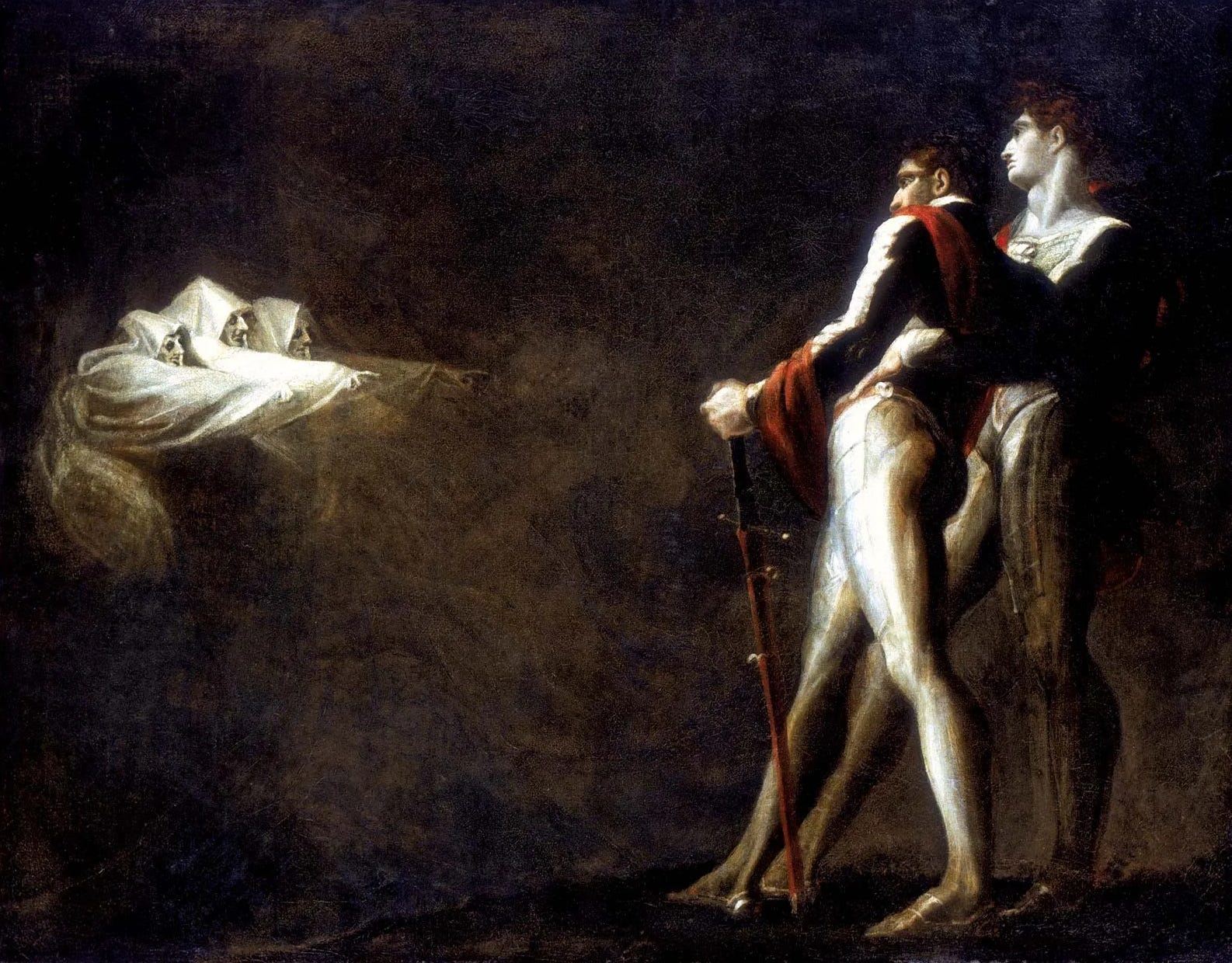
Even as “late” as Socrates and Plato, we are still provided with clear expressions of a type of submission, if not a reverential awe (σέβας), to the fundamentally irrational character of religious experience, which causes men to act “unlike themselves”. In Phaedrus, we are told of four gifts of divine “μανική”, mania, which are associated with a particular (now-anthropomorphized) power: Apollo’s gift of prophecy (μαντική), Dionysus’ gift of orgiastic ritual, the Muses’ gift of poetry, and Eros & Aphrodite’s gift of erotic passion. Each arise in their own circumstances and provide their own effects, but the mechanism is the same as it was for ἄτη or μένος—these are sudden and forceful changes in the psyche of a man, caused by the intervention of a god or daimon. The language used in Phaedrus makes this perfectly clear: the Muses, for example, “take hold upon a gentle and pure soul, arousing it and inspiring it to songs and other poetry”7, granting it a power that could not be otherwise generated on its own. This is revealing enough about what could be considered one of the earliest “psychologies” in recorded history, and indeed Plato does move to utilize these conceptions to that effect, but here we must reemphasize its connection to religious experience: it was by this way, a fundamentally irrational and “manic” one, in which the Greeks were struck by the activity of the divine, and where the meeting point of mortal and immortal lay.
Tellingly, the Christian inversion of the δαίμονες and gods into the bastardization of “demons”, “fallen angels”, hails from the works of the early Christian in Augustine8, Tertullian9, and Lactantius10, who conclude the intrinsically evil nature of the daimones precisely upon their irrationality and unpredictability, a chaotic nature attained in their separation from the rational Logos. The residue of far older belief is thus preserved here, too, in their very condemnations of it: it is external forces which do not belong to man’s rational mind that invade from without—possessing, intoxicating, arousing—driving him outside of his normal self, that is, into a state of ecstasy, through the works of “dreams and illusion”. The since-buried Greek of old would enforce the obvious conclusion in reply: the Christian indeed instructs us to seek a state free from such perturbations and monitions which “wander over the whole earth”, enticing man to act outside of himself—that is, he instructs us, to be soul-less!
Such is precisely the stature of a religion—if this word may even be used—that concerns itself merely with the orchestration of a rationally-derived “system of ethics”; it is soulless, it is without character, it is dead. Yet it is precisely this conception of religion which is hurried to the battlements to resist the assault of yet more rational and ethical demands. Truly, the early critics of Christianity possessed more insight into its nature than they knew by calling them ἄθεοι, god-deniers, as today atheism is nothing but the pure distillation of a rational and ethical Christianity, stripped of all of its unnecessary “superstitions”. If modern man will ever once again find it in himself to be religious, to solve the now centuries-old problem of “the disenchantment of the world”, then he must cast away any aspirations to will such a reality back into existence. He must reject demands to simply think his way to the gods, or to prove himself worthy of ascent and Revelation merely through good moral conduct. The divine cannot, will not, and never before has been found through a set of rational proofs or the applause of others towards one conduct. Nor will any deity magically appear once more once we, through the sincere labors of such introspection, unearth the archaeological structure of a “true” religious society. What do any of these tired horses tell us about what it is to experience divinity, which remains the actual subject of our loss and amnesia? The unlearned lesson of our long march into atheism, and a reaction which has only served to magnify its potency, should inform us of the appropriate reply: absolutely nothing.
It is for this reason that we—now nearing the end of our series—have spent so many words appealing to that long-forgotten kernel of religiosity: its fundamentally irrational component. Reason and ethics will do no man good in describing the nearness of a god which produces irrational and sometimes unethical behavior, yet is divine nonetheless. Ecstasy—Rausch—on the other hand, drives to the very heart of religious experience, and we have since provided a full array of examples and illustrations to this effect. Be it possession, intoxication, infatuation, frenzy, love, or any other such alteration of psychological states in moments of extreme or meaningful passion, the oldest of religious traditions and expressions tell us that these alterations are produced by the intercession of a deity. It is precisely in service to this reality that the tragic mask, arising out of the most ancient of religious expressions and ritual, captured both the character and the full array of its emotions in a single, expressionless object. More important to this type of performance was the intermingling and blurring between the souls of the mask’s depicted character and of the performer, which has been described by a variety of terms: participation mystique, or the principle of transformation. The result is the same in any case: man is driven out of his typical, rational self. In this brief moment he is possessed, and as it were for the actor, the affliction is only cured by removing the mask. This “affliction”, understood by Greeks as ecstasy, and by the Romantics as Rausch, are the clear and immediate results of the nearness of deity: δαιμονίζομαι. Whether or not the interaction will be good for the “victim” in question is entirely out of his hands; similarly, no man “wills” a powerful thought into existence, but is rather thrust upon by it. Try as he may, the source of his genius cannot be brought about by the snap of his finger; the author will hereby verify this fact through his many blocks and frustrations in writing. It must come from without, or perhaps, so deeply and so intimately within that the individual ego loses all power and semblance.
The reader may repackage these findings into more familiar concepts if he would like—a call for animism, a call for “archetypes”, a call for mysticism—but already we have begun to lose sight of the image. The most critical implication about our “Ecstatic Principle”, if we are to begin pitching name ideas and suggest a contrast with other such “Principles”, is that this view is not the typical “traditional” operation which seeks to reanimate the ancient world by stitching together, like Victor Frankenstein, what scattered limbs we may find. As useful as an anatomical investigation might be, the problem of such a view is concisely stated by Al Ghazali: “the essential condition in the holder of a traditional faith is that he should not know he is a traditionalist”. Indeed, even embarking on the enterprise of “traditional religion” not only implies the errors of historical thinking, but worse, draws the efforts of suppliance away from the gods and towards “correct belief”, or in our case, mere “correct reconstruction”.
Of course, the illustration of ecstasy as “the original content of religious experience” plays into this problem to some extent. However, the key distinction is that the Ecstatic Principle is a phenomenon liberated of the artificial constraints of history and setting; like the rites of Dionysus, it is available to all. History, in our case, is utilized only to illustrate that ecstasy is no novel invention but in fact the fundamental stratum of religious experience, evidenced by its forceful present in the furthest reaches of religious expression. Nevertheless, the past is forever gone—life’s flux demands it, scorning conceptions of “permanence”—and there is nothing to be done about this fact. Soon, it will come the time for our own waves to recess back into the shimmering ocean. What hope can there be for illustrious divinity in the downward grip of the vines of the Mater? The answer relies precisely in ecstasy: for it is precisely the souls of the past—perhaps more accurately, the eternal present—that gently land upon our shoulders in flickering moments of intoxication and infatuation, throwing us outside of ourselves, and into the past. These experiences too must cease, and we are inevitably thrown back “within ourselves”; the daimon has departed, and we are left to assess the result. Despite these limitations, never will the “pathic” recipient of such an experience deny its religious quality, bestowing upon him far greater experience and meaning than he may ever derive himself from rational assumptions: “it must be” will always pale in comparison to “it is”.
Thus, it is the ecstatic experience of soul which throws us into a connection with the religion of the past, and never shall it be the folly of relying merely on rational “reconstruction”. And it is here that we recall the wisdom of Zarathustra: to cast off our form of a limping camel, and to become a child—exuberant, and creative.
We conclude these thoughts, at last, with the helpful words of his later disciple:
Imagine the scene: a traveler returning after forty years, perhaps unaware of where he is, to the village where he was born, catches sight of the lime- tree, the roofs with chimneys puffing smoke, the narrow lane, the spring, the moss-covered churchyard railings, and is amazed; what he sees is not these things, just the same as other things, but he sees memorials of generations-old destinies, both of themselves and of the people who, in their shadows, by their banks, under their protection, blossomed and grew old, came and went, were noisy and were silent, hated and loved, found each other and separated; he sees what he remembers, covered up by the flow of those times which, while it was, roared past and, in roaring past, transformed it: who would dare to deny that he is about to be transported into the past! And if the sense of wonder overcame him with such force that it transformed him entirely in a trice, then the distance of time would be awakened in him, and what constitutes his present would not be these things, it would be the reality of the images which, linked by endless chains, reaches back into what has not beginning: ‘Primordial images are appearing souls of the past’.
—Klages, Samtliche Werks II, p. 846 (Trans. Paul Bishop, Ludwig Klages and the Philosophy of Life).

Of unknown etymology, but likely older than its association with tragedy and Dionysus. Regardless, it is widely acclaimed as the root of Greek tragedy, which in primitive form Aristotle called the “phallic processions”. (Poetics 1449a10–15)
Plato, Apology XXII. https://lexundria.com/plat_apol/22/j
As argued by Dodds in The Greeks and the Irrational, p. 79. He refers to the phrasing of Plato in Euthyd. 277 D.
See an interesting post and relevant citation here, on the Neoplatonic similarities to the ancient Egyptian Pyramid Texts.
“Athene, standing behind the son of Peleus, tugged at his golden hair, so that only he could see her, no one else.” Book 1, Verse 198.
Phaedrus, 244[b].
City of God, IX, III. “They resemble in character, though not in bodily appearance, wicked and foolish men. I might indeed say they are worse, inasmuch as they have grown old in iniquity, and incorrigible by punishment. Their mind, as Apuleius says, is a sea tossed with tempest, having no rallying point of truth or virtue in their soul from which they can resist their turbulent and depraved emotions.” https://www.newadvent.org/fathers/120109.htm
Apology XXII. “[…]with cruel lusts accompanied by various errors, of which the worst is that by which these deities are commended to the favour of deceived and deluded human beings.” https://www.logoslibrary.org/tertullian/apology/22.html
Divine Institutes, II, XV. (As separation from Logos): “Thus from angels the devil makes them to become his satellites and attendants. But they who were born from these, because they were neither angels nor men, but bearing a kind of mixed nature, were not admitted into hell, as their fathers were not into heaven.” https://ccel.org/ccel/lactantius/institutes/anf07.iii.ii.ii.xv.html
This was an interesting series to listen to on a long drive, thanks for writing. However, I find it strange that you equate Christianity nearly 1:1 with Reason / the cult of Reason given the supremely unreasonable nature of it. The early church called its rites “mysteries” instead of the sanitized “sacraments” and there’s even a theory in books like *The Immortality Key* that the original Eucharist contained psychoactive plant admixtures, although that book also trots out the tired “Christ is Dionysus because of the Canaan wedding miracle” thing so idk. Even today there are people sanctified for living as Fools for Christ.