


Uncontrollable, the unbeliever goes,
in spitting rage, rebellious and amok,
madly assaulting the mysteries of god,
profaning the rites of the mother of god.
—Euripides, The Bacchae (995-999)
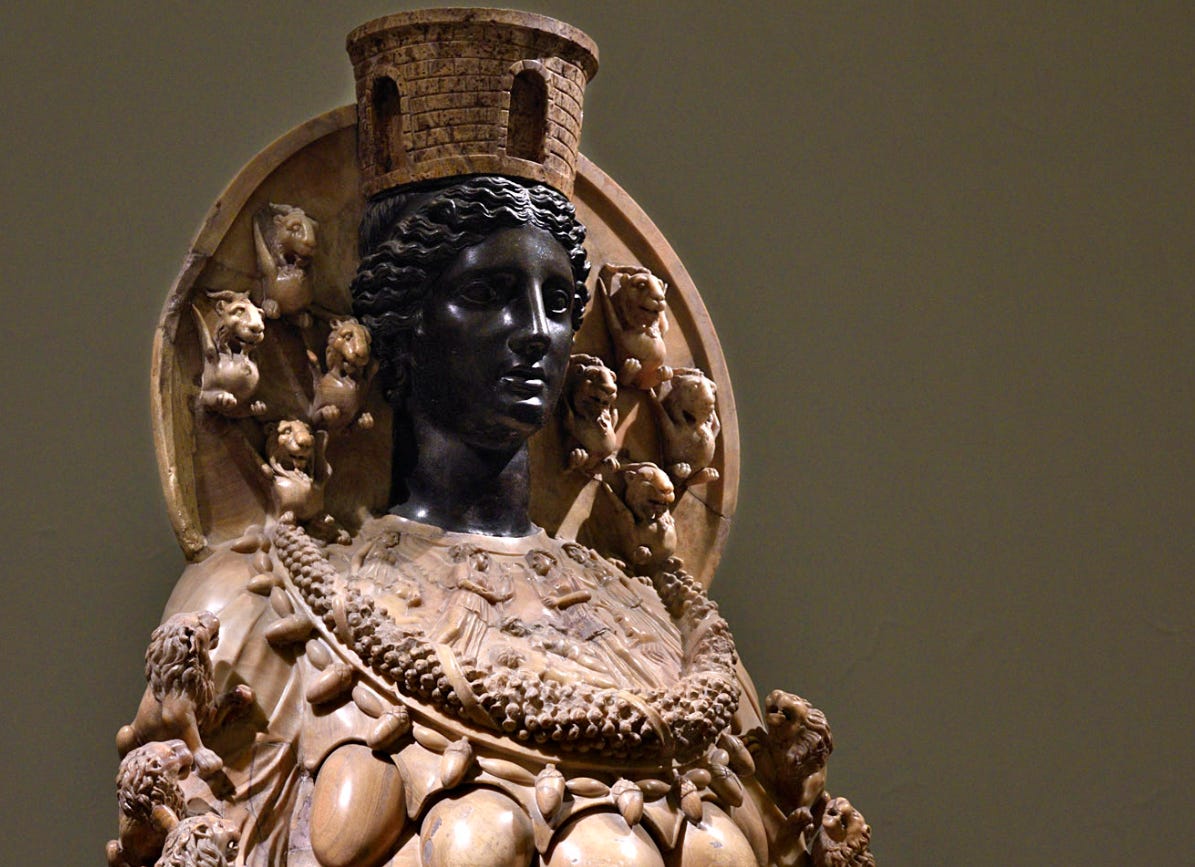
One may find it in a priest sanctifying an old house guilty of uttering a suspiciously demonic creak too many, or indeed as one is plunged below baptismal waters; too, perhaps, when the smoke of incense is waved about to clear a room of its spirits, and as well the cleansing of one’s body before entering the presence of gods: ritual purification exists as one of the most ubiquitous expressions of religiosity, across all barriers of time, culture, and race. We observe it in every corner of human expression available to the wandering eye.
You may find the most emotional, and therefore utterly foreign, example of this observance in the activities of the Athenian festival of Thargelia. By late spring, the fields were covered in verdant green thallos, young stalks of grain and cereal that were to be culled and offered to the gods. But what shall be offered must first be purified; thus the Athenians, on this day of every year, selected two of their own to serve as φαρμακοὶ.1 Two men, the ugliest of body and spirit that could be found, were cleaned, clad in holy garments, and adorned in wreaths and sacred flora. As a flute player processed them around the city, across every home, they were whipped with twigs and vines by the god-hungry people of Athens. Onto them they cast all sins and imperfections, all impurities and demonic essences, which these scapegoats strangely accepted… and then they were killed, their bodies utterly destroyed. Not the faintest trace of their flesh was to be found, bludgeoned and incinerated into dust along with every spirit cast upon them. Then, the jubilant festivities of a new spring heralded by the birth of Apollo began. In one moment the sludge that had accumulated in the polis’ preceding year had been driven out, and in another, the radiant beauty of the coming year was welcomed in.
It is customary to look at such episodes in antiquity with scorn and derision. In fact, the longstanding default of our worldview is to take the side of the ugly-and-pure offering, processed through the streets as he is whipped and injured as he ingests the sin of his fellow man. Here, we are told, is the final utterance of such a barbaric and senseless operation. Therefore, when the appearance of flesh-sacrifice presents itself once more, horror personifies the ensuing reaction, and charges of “heathenry”, “witchcraft”, and above all else, “the demonic”. In fact, in the few holdouts of contemporary life where religious sentiment still endures its laborious breathing, it is difficult to find any expression or occurrence of daily life that is not labeled as pagan or satanic. Of course, per the longstanding “wisdom” of those desert fathers, these two are one and the same, and already we are presented with the first of many errors that produce spiritual infantilization.
The confused and indeed oxymoronic assessment of post-Christian and counter-Christian sentiments as equally satanic, atheistic, and pagan is sometimes evident in just the front cover of popular bookstore titles, such as “Pagan Threat: Confronting America’s Godless Uprising”, which is dedicated “To the faithful—those who refuse to bow to Baal.” Indeed, out of a self-inflicted poverty which knows no occurrence of history outside of scripture, Baal has been erected as the “marbleman” of this apparent pagano-satanic-atheism, to which the chosen faithful are called to perform their customary act of nullification. Among a pile of curious claims (some of which, we should note, are openly admitted to by the author’s foes)—such as the demonic possession of Beyonce and Nicki Minaj, a gnostic-Hegelian feminist synthesis of Deepak Chopra and Oprah Winfrey, or the association of sage burning and meditative yoga with the worship of demons—the author is sure to include more familiar argumentation:
When a nation turns to idols, it does not remain spiritually or morally intact. This cycle of false empowerment, built on the worship of idols and the degradation of the human body, naturally paves the way for an even more demonic manifestation of power—a power that seeks control over life itself. This shift from sexual freedom to sexual dominance leads inexorably to the ultimate act of control: Abortion. Just as ancient deities demanded sacrifices, the modern goddess movement claims its power through the blood of the innocent.
—ibid.
No issue quite evokes the accusation of idolatry, “the demonic manifestation of power”, than the imagery of human sacrifice. The accuser is quick to list off the instances across antiquity where these acts were said to occur, contrasting this with the Biblical mandate to permanently end such behavior. Certainly, we would be cautious to reject this delineation on more than what would ultimately be trivial clarifications. Yet what must be fiercely contested is the insinuation that the sterile modern practice of the abortion pill has anything to do, whatsoever, with some form of non-Christian religiosity, and far less so a revival of the worship of the gods of antiquity. The identification of paganism with demons is a casual and longstanding belief within the Christian faith, yet the tail end of this triune moniker, which completes the circle, is all the more telling: this belief, actually, entails a disbelief. Not merely the disbelief of the Christian God, but of all gods, leaving only the individual man as worthy of veneration. To the extent that this is, in fact, the residue of a uniquely Abrahamic view of the world which elevated mankind to be worthy of such worship above nature, we direct to what has already been said.2 Nevertheless, the implicit admission that this worldview possesses an inherently atheistic flavor serves, as we shall see, the fundamental distinction between ancient man and those who claim the names of his gods, as well as the pastor, who is evidently confused by the vandalism.
To what extent can these activities be said to be a genuine reanimation, even if subconsciously so, of the worship of gods dispensed with some centuries ago? We return to the Athenian Thargelia for more clarification. The entire affair occurred because of, in part, the threat of or active presence of debilitating famines or outbreaks of disease. Thus, at least on an excruciatingly surface-level interpretation, we may say that these men were sacrificed in service to the protection and very survival of the polis. Already we see one key distinction, yet we must proceed further: as the philologist and historian of Greek religion Walter Otto tells us, looming over this rather serious and existential affair could only be the presence of a god. While modern man concerns himself solely with utility, ancient man knew only service and veneration. He explains:
The horrifying pomp of this tragedy, however, demands, as its counterpart, something portentous—a sinister, lofty greatness to whose presence the community responded with such terrible seriousness. There is no name we can give to this dark Being whose giant shadow fell over the habitations of mankind. His myth was the cult practices themselves which created for the destroyer his image in a gruesome drama. But this image would have never been created if he had not been overwhelmingly revealed from a position of immediate imminence. That which appears to our dull, unimaginative minds as a menace and poison of a material nature endowed the great generations of antiquity with a wealth of forms not because they thought about these matters even more superficially and mechanistically that we ourselves do, but rather because this image reared itself up before them as a colossal form which was not to be avoided, and forced them to express their emotion creatively in an awful monumental act. More exactly expressed—their ceremonial actions and the revelation of this colossal form were one and the same thing. Nor would they have been affected as deeply by the supernatural, as their creativity intimates, had the idea of utility been an integral part of their cult practices.
[…] That which seemed “primitive” and “understandable” to the evolutionists [Wilamowitz, Usener, etc.] was that which was secondary in nature: the regard for material wellbeing, which, it is true, soon had to be valued as the most important element by the unoriginal thinkers of later generations and was suited here, as elsewhere, to make sacred rites into acts of good common sense.
—Dionysus: Myth and Cult, pp. 40-41
The principal error committed in essentially all evaluations of ancient religion is the projection of utility onto those long-extinct cults. The modern scholar can only understand these expressions in terms of use and personal gain, because man himself remains as the sole deity to which offerings and veneration are presented. Unlike the modern culture crusader who sees his faith as a legal construct which can be raised against the coming tide of Islam, or the diligent missionary concerning his work with the material and spiritual enslavement of distant peoples in service to his own fetishes, ancient man knew nothing of his religion’s “utility”. He knew only the presence of the gods and the cultic practices which poured out of the hearts of those who bore witness, neither of which are present in the utilitarian mind of “the pagan-satanic left”. When the Phoenician offered his first-born child to the pyre, what do you think would have compelled him to such a dark act—and indeed they understood it as such—contrary to the instinct universal to all of life? “To project the slaughter of the hunt onto the maintenance of public order” as Burkert and Girard tell us3, or “to purchase and claim dark powers for himself” as the amateur exorcist would claim today. Neither conception of a sort of “spiritual economy” is rooted in the mind of ancient man4, but in fact can only come from the modern mind. Conversely, we know precisely why women procure abortions: to buy themselves 6 more years of financial independence, free from responsibility, happy in her undisturbed creation of more sales PowerPoints in a twelfth-floor cubicle. The overwhelming sense of a demanded submission is nowhere present; to the extent she may ululate about Artemis or Cybele, we may comfortably call everyone involved a liar.
These facts are likewise evident in the very mood or emotion present in these respective events. When ancient man offered another as a sacrifice to the gods, how is he said to have viewed the affair? As we are told, with the utmost seriousness and emotional vividness, at the knife’s edge between destruction and the necessity to obey the nearing-god. He understood it to involve the complete lack of control over himself, and indeed, offerings were said to have been given to the Fates as part of these rites as well. Conversely, what emotions does a woman feel today as she patiently sits in a waiting room before the administration of poison which will slowly kill her unborn child? To this we must necessarily reply: nothing at all. Our epoch is defined by the numbing anti-depressant, entrenching and enforcing the dull aloofness and utter separation from all sensuality. If there is any feeling present in the clinic it is anxiety, which is merely the anxiety that one will be stripped of her normal routines. Our contemporary mass anhedonia must be utterly contrasted with the rapturous ecstasy at the center of ancient rites and cults. For as much as one may gesticulate about the “sacred” nature of this clinical procedure, justified by self-serving allusions to the rights allotted to “divine femininity”, the act is precisely as it appears once stripped of all plastic accessories: quiet, unceremonious, and above all else, in respect and in service to the privacy of the individual. Indeed, privacy is the key word to any amendment, court ruling, or campaign slogan (to further distinguish it from anything “sacred”), as we find in “the right of privacy”, “guarantee of personal privacy”, or “the privacy of the informed-consent dialogue between the woman and her physician” throughout these elements. What could any of this possibly have in relation to the fundamentally public rituals of old, from which abstaining in participation could only incur fatal charges of ἀσέβεια?5
If Dionysus walks this Earth, he has assuredly been wired to an IV pole in a Toronto MAID ward.

The great “Nature gods” of antiquity—be it Dionysus, Artemis, or Cybele—to be sure, have nothing to do with the modern presentation of “Mother Earth”, a mere permissive godmother who gently guides humanity through daily life, and to whom environmentalists adoringly request peace, love, and forgiveness. Yet the gods of antiquity whom these plastic inventions imitate in the crudest fashion could only be described with the missing, indeed inverted, character: terror. Cybele, we are told by Lucretius, was depicted as a terrifying woman who charges down her heavenly peak in the form of a black meteor, hoisted upon a chariot driven by two ferocious lions, guarded by a Phrygian warband who blared horrible horns, bashed spears and bronze shields as they danced, and howled and shouted for blood. Dionysus and his maenads need little introduction in this regard, though we may remind the reader of a few epithets: the hunter and renderer of men, Ωμάδιος, the eater of raw flesh (a title shared only with Cerberus), and as kept in the Hymns of Orpheus, he who delights in “swords, and blood, and sacred rage”. Artemis likewise strikes terror into the hearts of men, though in a noticeably colder character than the other two: countless souls were destroyed in the most gruesome ways for the most infinitesimal of slights to the goddess—cursed Agamemnon’s daughter Iphigenia, curious Actaeon, and even her faithful Hippolytus. While we shall leave further investigation into this tangent for future works, this much is noted to remind the reader that ancient man understood all gods, and particularly the nature gods, as terrifying, demanding, and uncompromising forces which sought to destroy as much as they bestowed life. In fact, the two gifts were inseparable.
In addition, we must refer to what exactly this confers to the individual, namely her “right to choose”. We are told that the Earth Mother is invoked and offered the souls of children in specific service to this “bodily autonomy”, this freedom of will and of the individual, yet we see in ancient myth and cult the precise opposite of this claim. When Euripides tells us the story of Pentheus, King of Thebes, torn apart limb-by-limb by his own mother, it is noted that she was entirely maddened by Dionysus, and, through the hallucinations of divine frenzy thought her son to be a wild lion. Modern terms such as “epilepsy” and “seizure” still retain their original Greek meaning from λᾰμβᾰ́νω, meaning “to be seized from without”—implying the internal activity of a daimon or god. Plato himself in Phaedrus offers us several “blessings” of madness, where the individual is compelled beyond himself: the prophetic madness of Apollo, the mystical madness of Dionysus, the poetic madness of the Muses, and the erotic madness of Eros and Aphrodite. Time and time again, when we observe the activity of a god and particularly in relation to his worshippers, we witness nothing short of the complete destruction of the individual—sometimes but for a moment, other times permanently—and thus this activity must stand in the strongest opposition to those conceptions which elevate the autonomous individual and their “rights” above all other things!
Those who suggest the involvement of demons in the act of abortion or sexual depravity may offer that insanity and madness, in fact, aptly describe the entire phenomenon of the “modern progressives”, who, like the Bacchantes, seek to liberate themselves from the duties and responsibilities of daily life in favor of psychosis. Though we hope that we have already dispensed with the view that cultic veneration came through a rationally-sought benefit to the self such as “the release from one’s duties” and not the overpowering presence of a god—or demon, if a Christian were inclined to agree—it should be further demonstrated that whereas one madness arises from the total possession of a god, the other arises from nothing short of its total absence. We need to only revisit the language and behavior of “the possessed”: rites of self-help, prayers of self-affirmation, and above all else, the impiety that results from the belief that a god is to be used for his own benefit. Thus, the confusion stems from the entirely biblical belief that idolatry is merely that which seeks to venerate the self, making man himself the ultimate “graven image”. Here the desert father, mid-century scholar, and Neoplatonist, too, all find themselves in an agreed-upon ignorance in ascribing to the ancient mind a view of religion which seeks to merely engorge himself on divine powers, even as this conception reveals itself to be utterly incapable of explaining how these myths and cults arose in the first place, or how each and every one of them entail the complete loss of individuality, often at grave cost.
When we permit ourselves to engage in a genuine assessment of the character of these types, what sort of qualities do we find? Above all else the veneration of progress, a rejection of the tyranny of nature, an overbearing demand for apparent “human decency”, and the sacred protection of the rights of the human individual. Not one of these qualities were known to the Greek, and this leads us to ask, where, then, did they come from? Ultimately, Christianity! Surely, these express themselves in a clearly heretical manner; just as much as we can attribute the genesis of these views to Christianity can we say that the religion is very obviously no longer in control of the situation. How at all, then, can a “revival of the worship of gods” be defined by the mere residue of a since-abandoned Christianity? Perhaps this is precisely what these types want, a system of Christian ethics stripped of all sacral obligations and lacquered with the images of antiquity (they would not be the first to try!), but with this we may safely discard the notion that we are presented with the most remote sense of contact to any deity.
Christianity aimed at the preservation of the individual ego, in whose service it preaches “compassion.” Christian compassion is hostile to life, because the laws of life are not the laws of the ego: therefore, Nietzsche was correct in spurning it. The paganism that he wished to proclaim, on the other hand, was a splendid surrender of the ego and, hence, a phenomenon of life.
—Klages, Rythmen und Runen, p. 303
With the most fervent enthusiasm we dispense with the notion that the character of the apparent “pagan-satanic Left” has anything to do with “the worship of idols”, be they gods, demons, or some other supernatural or psychological presence. With the exception of those wondrous ancients, all are in agreement that man himself is in some sense divine—only the impious today has stripped all other divinities but him. He surrounds himself with innumerable temples and well-kept altars to this fact, and none are held in so high regard than the autonomy and free will of the individual. Here, he demands that he be permitted to do what thou will with no holds barred, imprinting upon Nature his own foolish whims then mistaking the resemblance as divine license. In his state of pure ego, his excretions of anhedonic miasma, and his demand that all of existence act in service to him alone, he situates himself as nothing short of the complete inversion of antiquity; and to the extent this persists, the pastor should not look to the old gods for the root of his concerns, but to his own necrotic flesh.

Pharmakoi, scapegoat. Likely a play on pharmakeia, the use of healing/witchcraft.
See Lynn White Jr’s Roots of Our Ecologic Crisis, or Manfred Gerstenfeld’s Neopaganism in the Public Square, both of which highlight the Pagan view of nature in opposition to the Abrahamic.
See Burkhart’s Homo Necans, or Girard’s Violence and the Sacred.
See Daniel Ullicci’s The Christian Rejection of Animal Sacrifice and related writings for a scholarly analysis of ancient thought in regards to sacrifices, and how it differed with the Christian worldview.
Asebeia, impiety, specifically of the kind charged to Socrates.
There is nothing in the Bible to prohibit human sacrifice, or even polygyny. Only the sacrifices to any other gods were forbidden. Those are traditions, not scriptures. Even the Protestants failed to realize this, which only proves that they are just as tradition-bound as the Catholics they complained about. And isn’t death penalty a human sacrifice to Lady Justice?
Yeats suggested the first individualists were the Stoics:
"After Plato and Aristotle, the mind is as exhausted as were the armies of Alexander at his death, but the Stoics can discover morals and turn philosophy into a rule of life. Among them doubtless - the first beneficiaries of Plato's hatred of imitation - we may discover the first benefactors of our modern individuality."
But then a page later he says: "This Church...will make men also featureless as clay or dust. Night will fall upon man's wisdom now that man has been taught that he is nothing." But that last bit was as much a response to the effect of scientism.